

Here is how to write a sales proposal with AI: ask a fixed set of questions on one recorded call, give the transcript to an AI assistant that knows your proposal structure, and read and correct the draft before you send it. For a simpler project, this turns hours of work after the call into 5 to 10 minutes.
Vladislav German, founder of Deeps Solutions, is not a full-time salesperson. He handles inquiries, intro calls and proposals, and after each call he used to spend hours thinking the proposal through and amending it. Today a Claude skill writes the first draft from the call transcript. In a recorded conversation with Benjamin Wallmann, partner at Deeps Solutions, he called it the number one AI use case for sales teams right now.
Key takeaways
- A clear sales proposal has six parts: a one-sentence summary of the problem, the current situation, the approach, what is out of scope, the price and the next step.
- The AI can only use what the client said on the call, so ask fixed questions and make sure the client says the answers out loud.
- You can build a proposal skill in Claude without code: do the work once in a chat, then ask Claude to turn that chat into a skill.
- The AI writes the first draft, and you still read it, correct it and add what only you know.
- Send a proposal after one call only when that call was a real discovery, and book the next step when it was not.
What is a sales proposal?
A sales proposal is a document that tells a buyer what problem you will solve, how, by when and at what price. It turns a conversation into a decision. In B2B sales, it has a second job: the person you spoke to often has to show it to a manager, finance or IT, who were not on the call.
So the proposal must make sense to someone who never heard the conversation. A reader who skims the first page should understand the problem, the plan and the price.
How to structure a sales proposal
A clear sales proposal has six parts, and each part is filled by an answer the client gives on the call. Five of them are the sections Vlad’s proposal skill builds. The out-of-scope block is his advice from another recorded conversation.
| Section | What it says | The question that fills it |
|---|---|---|
| Summary | The problem in one sentence, then 3 to 5 concrete outcomes | What are you trying to achieve? |
| Current situation | The main pain, what is urgent, what matters later, hard constraints | What does not work today, and what happens if nothing changes? |
| Approach | Phases, each with a purpose, deliverables and estimated effort | What do you use now, and who will work with the result? |
| Out of scope | Topics from the call that this project does not cover | Everything else the client mentioned |
| Price and payment | Effort and price per phase with the math shown, and payment terms | What budget do you have in mind? |
| Timeline and next step | Start date, delivery dates and what happens to begin | When does this need to work, and who else decides? |
Three rules make this structure work:
- Write the summary for outsiders. One sentence on the problem, then outcomes the buyer can check later.
- Show the math. If a phase takes 40 hours, show hours times rate and the amount of each payment, so nobody has to calculate.
- Add an out-of-scope block. Calls drift into side topics, such as a newsletter or an outbound idea. Vlad moves all of them into a block that says what this project does not include.
Ben explained why that block matters:
They will expect everything that they talked about on that call.
Benjamin Wallmann, partner at Deeps Solutions
The block also shows the client you heard them. When the topic comes up later, you can say it belongs to a later project. More on this in how to prevent scope creep.
How to write a sales proposal with AI, step by step
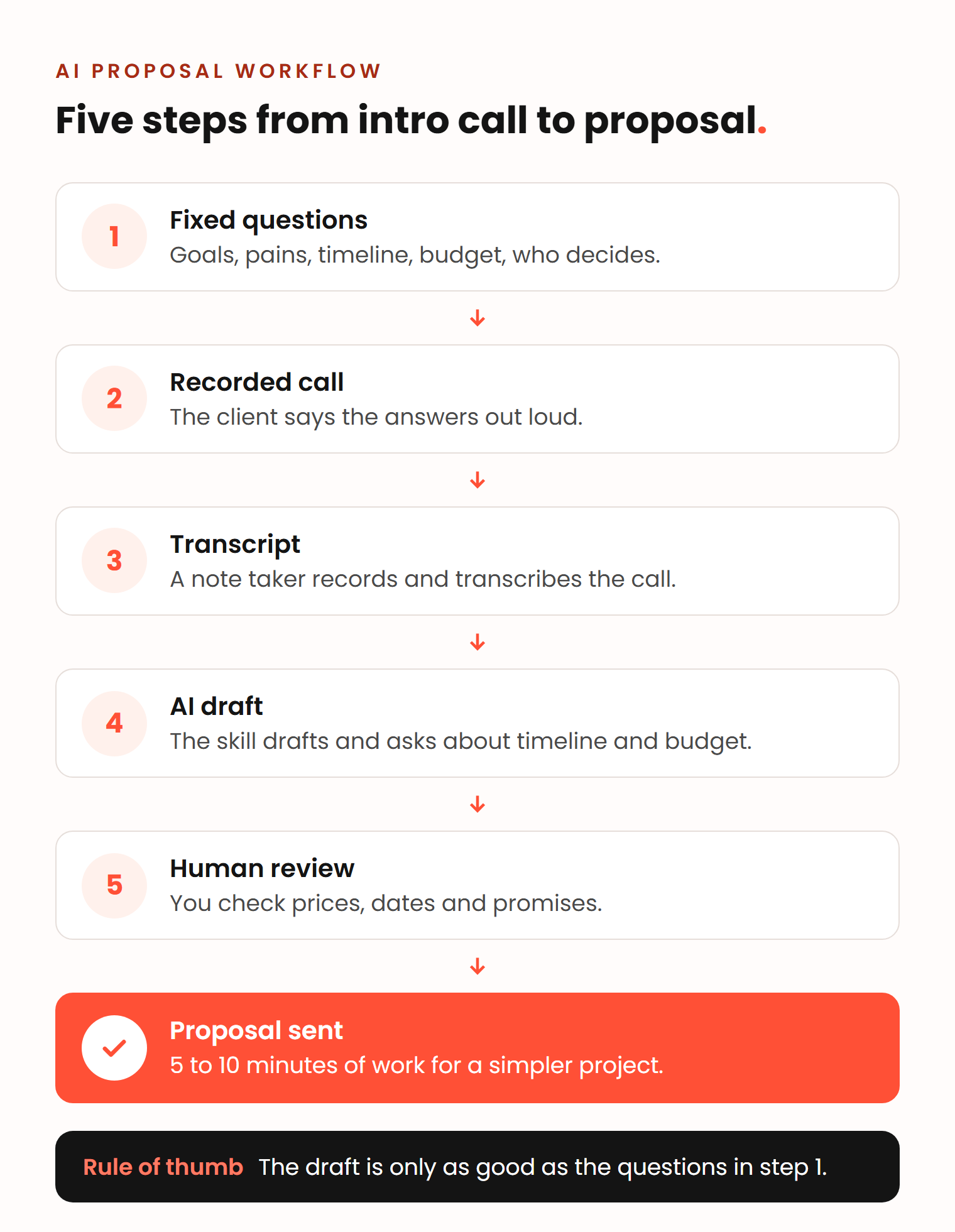
The workflow has five steps, and the last one needs your full attention. Sales proposal automation here does not mean sending without reading. It means the first draft is ready shortly after you hang up.
1. Fix your questions before the call
Vlad keeps a list of questions for every intro call. Their purpose is to collect everything he needs to send a proposal, or at least a preliminary one, right after the call. He does not read them like a script, but he keeps them in mind and makes sure each one gets an answer. If you do not have a list yet, start with our sales discovery questions and the right column of the table above.
2. Make the client say the answers out loud
Even when Vlad already has an idea of the answer from outside the call, he asks the client to talk him through it: their goals, their pain points, their timeline. The AI only sees the transcript.
It is important for them to say this on the call so that it appears on the recording, and I have it on the transcript.
Vladislav German, founder of Deeps Solutions
3. Record the call and get the transcript
Any AI note taker works. If your team uses HubSpot, its Notetaker records and transcribes Google Meet, Microsoft Teams and Zoom meetings and suggests next steps. As of November 2026, it is available in Sales Hub and Service Hub on the Starter, Professional and Enterprise plans, for users with an assigned seat. Tell the client at the start that you record the call and why.
4. Let the AI draft, and answer its questions
Vlad’s skill expects the intro call transcript as its input. It knows that the answers to the proposal questions are somewhere in that conversation, and it returns a draft proposal. On the way, it asks him a few clarifying questions, for example to double-check the timeline and the budget he wants to put in. Those are decisions only the seller can make.
5. Read, correct and send
The AI does not do the thinking for you. Ben was clear about this:
You read through it, and you tell it what to change and what to add, because Claude doesn’t know everything that you’re thinking, of course.
Benjamin Wallmann, partner at Deeps Solutions
Check every price, date and promise against the call. A draft can repeat a misunderstanding from the transcript and sound fully confident about it.
How do you build a proposal skill without technical work?
Do the whole job once in a normal Claude chat, then ask Claude to turn that chat into a skill. No code is involved. A skill is a saved set of instructions and files that Claude loads when a task needs it (Anthropic’s definition).
- Do it once by hand. Start a new chat. Paste a call transcript, a past proposal you are happy with, and your list of questions. Ask for a proposal in the same structure. Correct the draft until you would send it.
- Turn the chat into a skill. In the same chat, ask Claude to create a skill from what you just did. As Ben put it, you tell Claude to build a skill off of this, and it builds it. Anthropic’s guide describes what happens: Claude asks about your process, writes a SKILL.md instruction file, adds your materials and packages it. You save it and switch it on in Claude’s skills settings.
- Test it on the next call. Run the next transcript through the skill. When something is off, ask Claude to update the skill, as the same guide recommends.
As of November 2026, skills work on every Claude plan, including Free, as long as code execution is switched on in the settings.
In effect, this is an AI proposal generator that writes in your structure and your words, because it learned from your own example. Proposal software with templates and e-signatures can still handle the sending.
How much time does AI save on a proposal?
For a simpler proposal, Vlad’s work after the call went from hours to 5 to 10 minutes. The hours used to go into thinking the offer through and amending it. Ben puts the saving at about half an hour on small proposals and two hours or more on big ones.
Both numbers depend on step 1. If the call did not answer the questions, no tool can fill the gaps, and you are back to emails and guesswork.
When should you not send a proposal after one call?
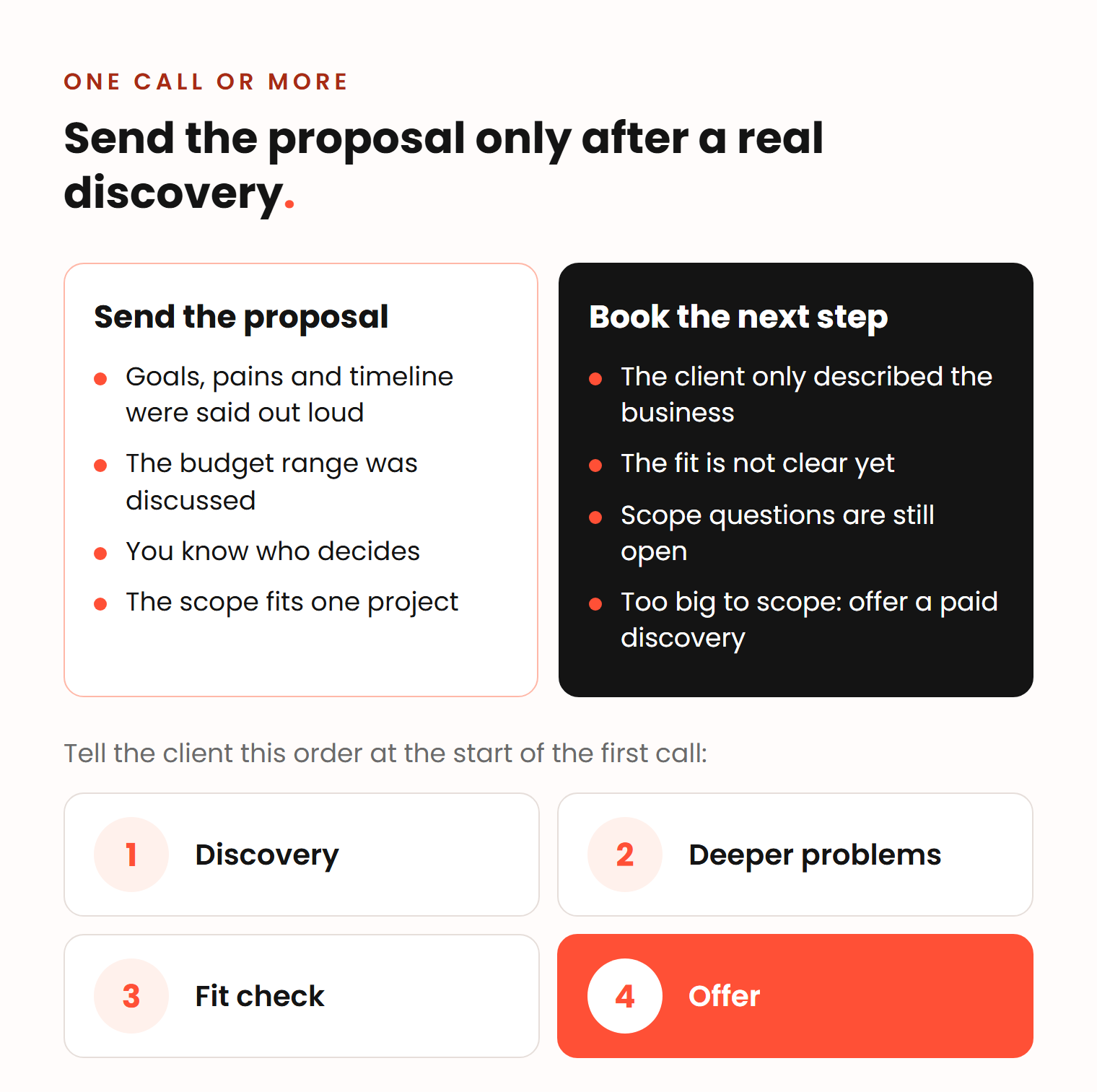
Do not send it when the first call was not a real discovery. Robin Dijst, a HubSpot freelancer from the Netherlands, looks at CRM data to find out why deals did not close. He sees this a lot.
We see that a lot of times people are jumping too fast into the proposition.
Robin Dijst, HubSpot freelancer, Pack of Nodes
In those calls, the customer was only describing what they do and how they work. The fit was not clear yet, but the rep felt it was a great first call and sent an offer.
This sounds like the opposite of the workflow above, but it is the same rule seen from the other side. Ben’s advice is to know exactly what you need for a proposal and get it in one call, or two if the project is complex. Deeper discovery after that belongs in the paid project, not in a sales process where nobody earns money yet. The AI workflow works because the questions come first. A transcript of a pleasant chat produces a pleasant proposal for the wrong problem.
Robin adds a simple fix: tell the client your process at the start of the first call. Today is discovery. If there is a fit, next time you go deeper into their problems, then you check the fit together, and then you make an offer. The client knows what comes next, and the offer does not arrive as a surprise.
Three more limits to keep in mind:
- The AI does not know your judgement. Price, risk and what to leave out are your decisions, and the draft builds on your answers.
- Transcripts hold client data. Check your company’s rules before you paste a transcript into an AI tool.
- Some projects are too big for one call. When you cannot scope the work from a conversation, propose a paid discovery first and quote the rest after it.
How Deeps works with proposals
Every Deeps project starts with an analysis of how the team sells. You get a quote after an intro call, and complex projects start with a paid discovery that produces the plan. Vlad drafts our own proposals with the workflow above.
If you want your team to work this way, the fixed questions and stage criteria come from your sales process. Our Sales Process Consultancy defines them with your team, from €1,500 in 2 to 4 weeks. Setting up HubSpot’s own AI features around that process is covered on Smarter HubSpot with AI. For more AI workflows before, during and after calls, read how to use AI in sales.
Frequently asked questions
How do you structure a sales proposal?
Start with a one-sentence summary of the problem and 3 to 5 outcomes. Then describe the current situation, the approach in phases, what is out of scope, the price with the math shown, and the timeline with the next step. Each part should be filled by an answer the client gave on the call.
Can ChatGPT write a proposal?
Yes. ChatGPT, Claude and other AI assistants can write a first draft of a sales proposal. The quality depends on what you give them: a call transcript with clear answers, an example proposal and your structure. You still need to check prices, dates and promises before you send it.
Do I need a paid Claude plan to use skills?
No. As of November 2026, Anthropic lists skills on every Claude plan, including Free, with code execution switched on in the settings. Check Anthropic’s help page for the current details.
Should you send a proposal after the first call?
Only if the call answered the questions your proposal needs: goals, pains, timeline, budget and who decides. If the client only described their business, book a second call first. For complex projects, offer a paid discovery before a full proposal.