

A good sales follow-up plan for a B2B lead is 6 to 9 touches over three to four weeks, mixing email, phone and LinkedIn, where every message adds something new. Most companies stop far earlier: in a 2013 test of more than 9,500 US companies, the median company made one contact attempt on a new web inquiry. Stop when the lead replies, asks you to stop, or when your own data shows that the next touch no longer brings answers.
Robin Dijst, a HubSpot freelancer from the Netherlands who works in the Pack of Nodes cooperative, often analyzes why deals did not close. The first call goes well. Nobody books the next meeting. Later the rep calls, the buyer is busy and asks for a call back later, and the rep starts to wonder what went wrong. The deal is not lost yet. It just has no next step.
Key takeaways
- Most teams follow up too little: the median company in one large test made a single attempt.
- Plan 6 to 9 touches over three to four weeks across email, phone and LinkedIn, then let your own reply data set the limit.
- Every follow-up adds something new: a fact, an example, a direct question or a clear way out.
- The cheapest follow-up is the one you never need, so book the next meeting before the call ends.
- Stopping usually means moving the lead to nurture, not deleting it.
What is a follow-up in sales?
A sales follow-up is any contact after the first one that moves a lead or a deal to its next step: a call back on a web inquiry, a second email to a prospect who did not reply, a recap after a meeting, or a question after a proposal.
There are two kinds. One gets a first reply from someone you have not spoken to yet, and it needs a plan. The other keeps a deal moving after a conversation. It should rarely be needed, because a good call ends with the next meeting booked.
When Benjamin Wallmann, partner at Deeps Solutions, asked Vladislav German, founder of Deeps Solutions, for three simple habits that win more deals, follow-up came first. Many teams skip it, because without a CRM and a clear process nobody tracks it.
How many times should you follow up with a prospect?
Plan for at least five or six touches across channels, then let your own reply data decide where to stop. Most teams stop much earlier, and the data shows what they miss:
- In the 2013 test, 47% of the companies never answered the web inquiry. The average was 2.2 attempts (XANT, 2014).
- 81% of sellers make five or fewer follow-up attempts (XANT, 2021).
- In Velocify’s study of about 3.5 million leads from 2012, 93% of the leads that converted were reached by the sixth call (Velocify).
- In Belkins’ study of 7.5 million emails sent in 2025, emails 2 to 6 brought 58.6% of all replies. The third email alone booked 35.6% of the meetings that came from email, more than any other step.
So the messages after the first one do most of the work, and most reps never send them. That does not mean there is a magic number.
There is no one silver bullet. So instead of saying you have to do seven touches before you drop, or 25 touches before you drop, we need to find a framework that would allow us to think, because it depends case by case.
Vladislav German, founder of Deeps Solutions
Vlad’s framework has two parts. For automated touches, set up about ten, run them, and look at the data. If almost nobody replies after the fifth touch, stop at five. For manual touches, the size of the deal decides. Personal follow-up costs a person’s time, so set a lower bar: if 70% of the people who reply do so within three follow-ups, stop at three and accept losing the other 30%. Bigger deals justify more manual touches.
The number of leads matters too. Ben’s point: when leads are scarce, each one deserves more of your time.
How far apart should follow-ups be?
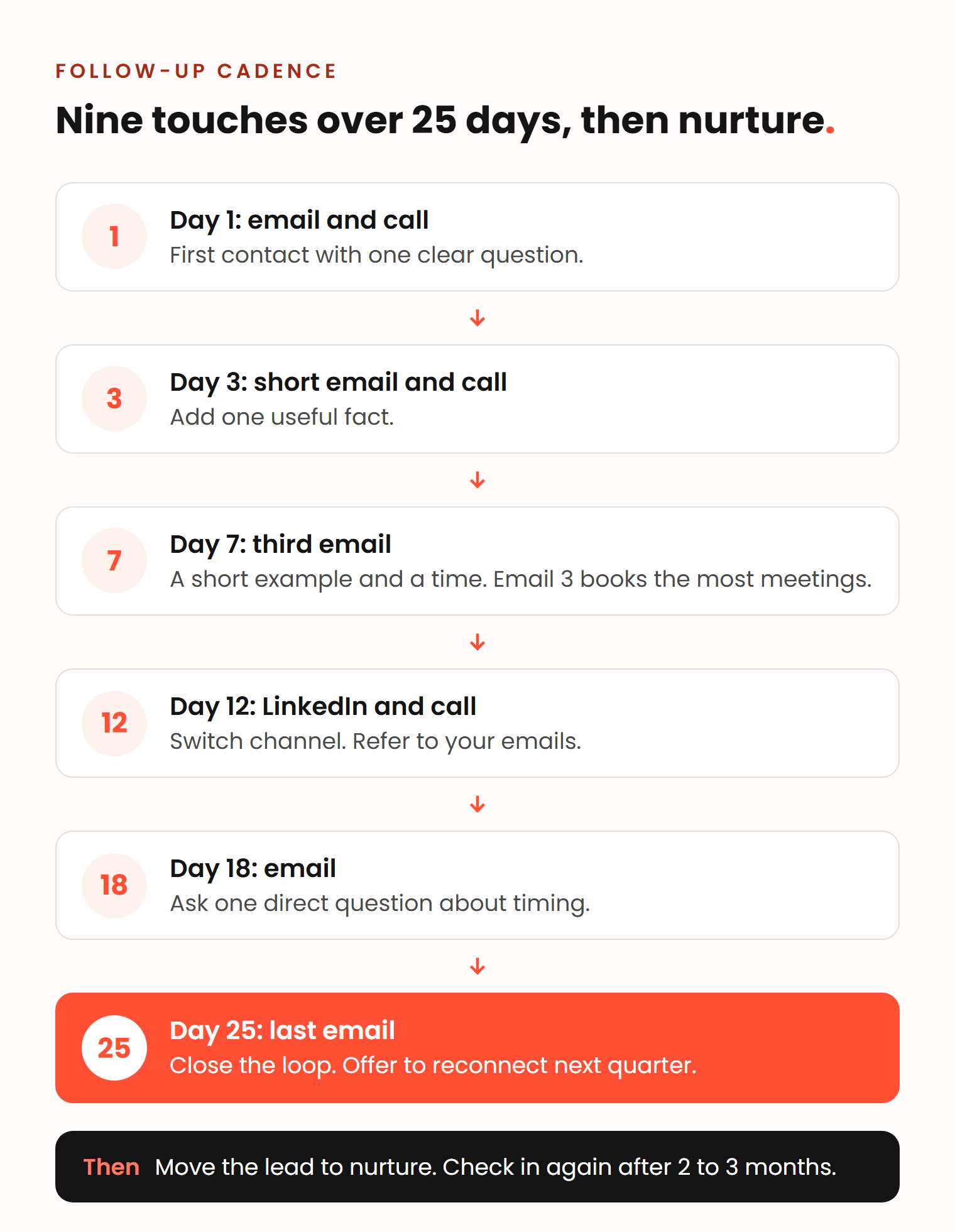
Keep the touches close in the first week, then space them out: day 1, 3, 7, 12, 18 and 25 is a good starting point for a lead who has not replied. Switch channel along the way, because a silent inbox tells you nothing. Belkins recommends 3 to 5 email steps, then a LinkedIn connection request that refers to your emails.
Adjust it to the situation:
- New inbound request. Speed matters more than the number of touches. In XANT’s data, conversion was 8 times higher when the first call came within five minutes. An HBR study found that firms that contacted a lead within an hour were nearly 7 times more likely to qualify it than firms that waited one more hour.
- Buyer went quiet after a call or a proposal. Send three or four personal messages over two to three weeks, each one referring to what they told you.
This spacing is our working default, not a study result.
What is a good sales follow-up message?
A good sales follow-up message is short, adds one new thing and asks one clear question. “Just checking in” adds nothing, so it gives the buyer no reason to answer. In Gong’s analysis of more than 85 million cold emails, follow-ups of one or two sentences doubled reply rates, while asking for permission to share a case study cut replies by up to 47% (30 Minutes to President’s Club). Put the example in the email instead.
Here are four follow-up emails after no response, one per later email in the cadence. Reply in the same thread.
Day 3: add one useful fact.
Hi Anna, one point I left out. Teams like yours usually lose the most time on [task]. [Similar company] cut it from [X] to [Y] by changing [one step]. Is that a problem for you as well?
Day 7: give a short example and a time.
Hi Anna, an example that may help. [Similar company] had the same [problem]. They started with [first change], and after [time] they saw [result]. If this is on your list for this quarter, I can show you how in 20 minutes. Does Thursday at 10:00 work?
Day 18: ask one direct question.
Hi Anna, one question so I don’t take more of your time than needed: is [project] still a priority this quarter, or should I get back to you in [month]?
Day 25: close the loop.
Hi Anna, I haven’t heard back, so I’ll assume [project] is on hold and close my file for now. Worth reconnecting next quarter?
The last message gives the buyer an easy way out. Belkins recommends this kind of final step: a small ask with a long time horizon. In Gong’s data, breakup emails raised reply rates by 89%. When we talked about this, another closing line came up that works for many teams: ask whether the buyer is giving up on the project. Nobody likes to give up, so people often answer. In a formal market it can sound like pressure, so use it with care.
How do you set the next step so you rarely need to follow up?
Book the next meeting before the call ends. When Robin looks at lost deals, the missing next step is the mistake that hurts most:
Maybe the most painful thing is that there’s no next step. You had a great chat with a potential customer and you don’t close off with planning another meeting or planning another follow-up.
Robin Dijst, HubSpot freelancer, Pack of Nodes
Ben’s fix is simple: ask while you are still on the call.
On the call, usually it’s way easier. Just saying: let’s have a follow-up, let’s book something for next week. And usually people don’t feel comfortable saying, no, let’s not do it.
Benjamin Wallmann, partner at Deeps Solutions
Robin adds one habit: tell the buyer your process at the start of the first call. Today is a discovery call. If there is a fit, next time you go deeper into their problems, then you check the fit, then you make an offer. When the buyer knows what comes next, asking for the next meeting feels normal.
Use the last five minutes of every call for four things:
- Sum up what you heard in two or three sentences.
- Name the next step and why it helps the buyer.
- Offer two times and send the invite while you are both still on the call.
- Send a short recap the same day with the date, the agenda and who prepares what.
Then record the next step and its date in the CRM. A deal without a next step date is the first thing a sales manager should ask about. Our guides to sales discovery questions and building a sales process cover what to collect on the call and when a deal moves to the next stage.
When should you stop following up with a lead?
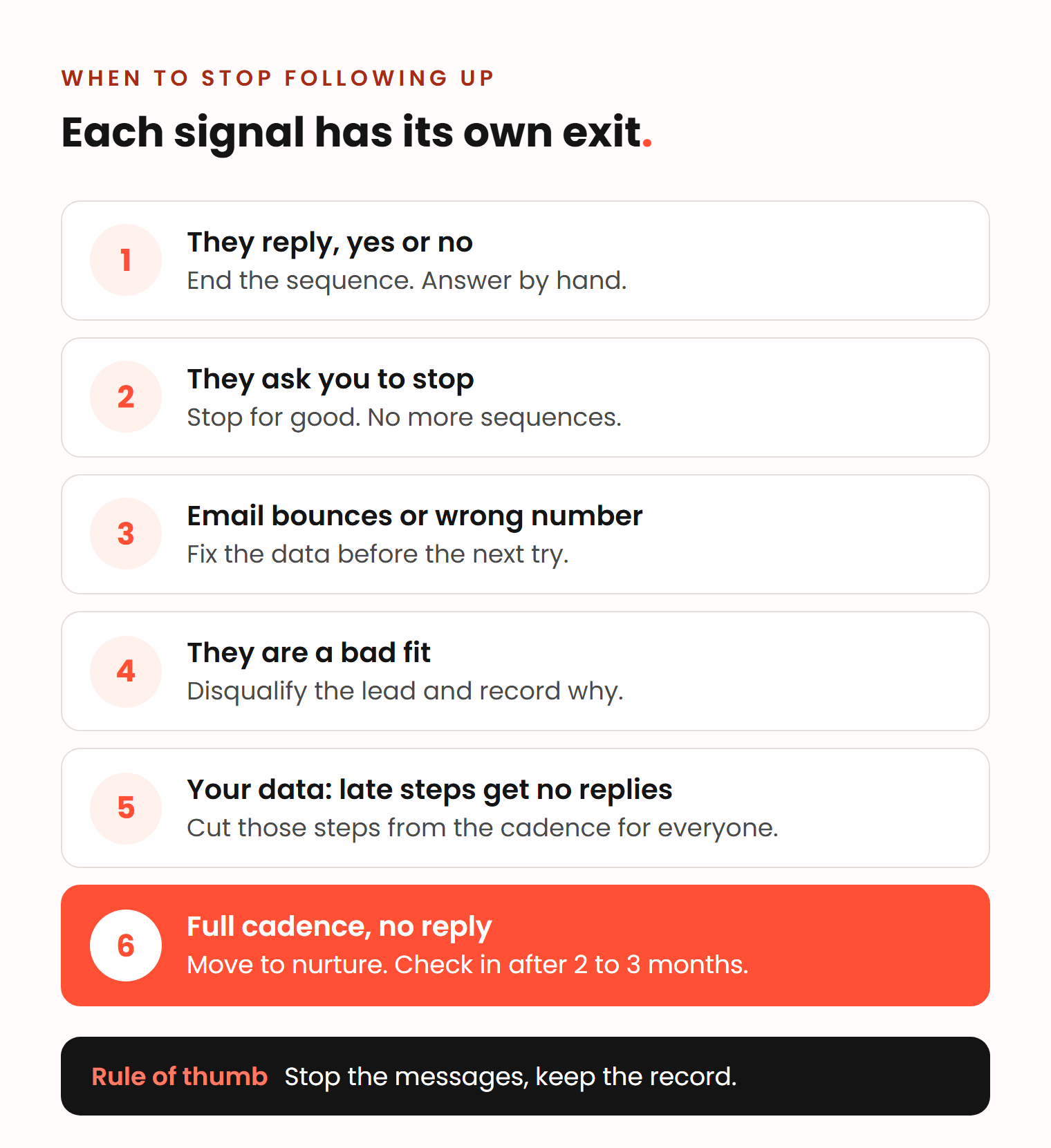
Stop when the lead answers, asks you to stop or turns out to be a bad fit, or when your own data shows that the next touch no longer brings replies. Stopping does not have to mean deleting:
- Any reply, yes or no: end the sequence and answer by hand.
- A request to stop or an unsubscribe: stop for good.
- A bounced email or a wrong number: fix the data before you try again.
- A bad fit: disqualify the lead and record why. Lead qualification is part of follow-up. Ben argues that when you sell a service, a rep who qualifies every lead is probably not asking the right questions.
- Late steps that never get replies in your data: cut them from the cadence for everyone.
- A full cadence with no reply: move the lead to nurture. Check in after two or three months, or when something changes at their company. Do not restart the same sequence.
Why not follow up forever? Ben asked exactly that when we went through the data. There are two reasons. The first is spam complaints. Google asks every sender to keep the spam rate below 0.3%, and your email domain is shared, so one rep who keeps writing to cold lists can push the whole team’s email into spam folders. The second is the cost of the next message:
There is a hidden cost. While you are sending messages to this person, even if it’s automation, you could have been sending those messages to somebody else.
Vladislav German, founder of Deeps Solutions
Leads that are hard to reach are also weaker leads. In the Velocify study, leads that needed seven or more calls to reach were 45% less likely to convert, even after contact.
How we set up follow-up in HubSpot
We put both kinds of follow-up into the CRM. The automated part runs in HubSpot sequences. By default, a contact leaves the sequence when they reply or book a meeting through a link in it (HubSpot, as of November 2026). The step report shows replies and meetings per step, so you can see where your cadence stops paying. The manual part runs on tasks with due dates.
For Dominius, a door company in Norway, every open lead and deal has a task, tags flag leads with no task or no recent activity, and leads that never reply are closed automatically. To decide what to automate first, read our guide to sales process automation, or see how we build workflow automation and set up HubSpot for sales teams.
Frequently asked questions
How long should you wait to follow up after no response?
Wait two days for the first follow-up, then make each gap a little longer: four, five, six and seven days. That puts the last message about three and a half weeks after the first. For a new inbound lead, call within five minutes and try again the same day if you miss them.
How many follow-ups are too many?
It is too many when the later steps stop bringing replies in your own data, or when spam complaints rise. For most B2B leads who have never replied, 6 to 9 touches over three to four weeks is enough. After that, move the lead to nurture.
Should you send a breakup email?
Yes, as the last step. Keep it short, say you will close your file, and ask whether to come back next quarter. In Gong’s data, breakup emails raised reply rates by 89%.
Should sales follow-ups be automated?
Automate the reminders and the first sequence for leads you have not spoken to yet. Write the follow-ups after a real conversation yourself, because they need to refer to what the buyer told you.