

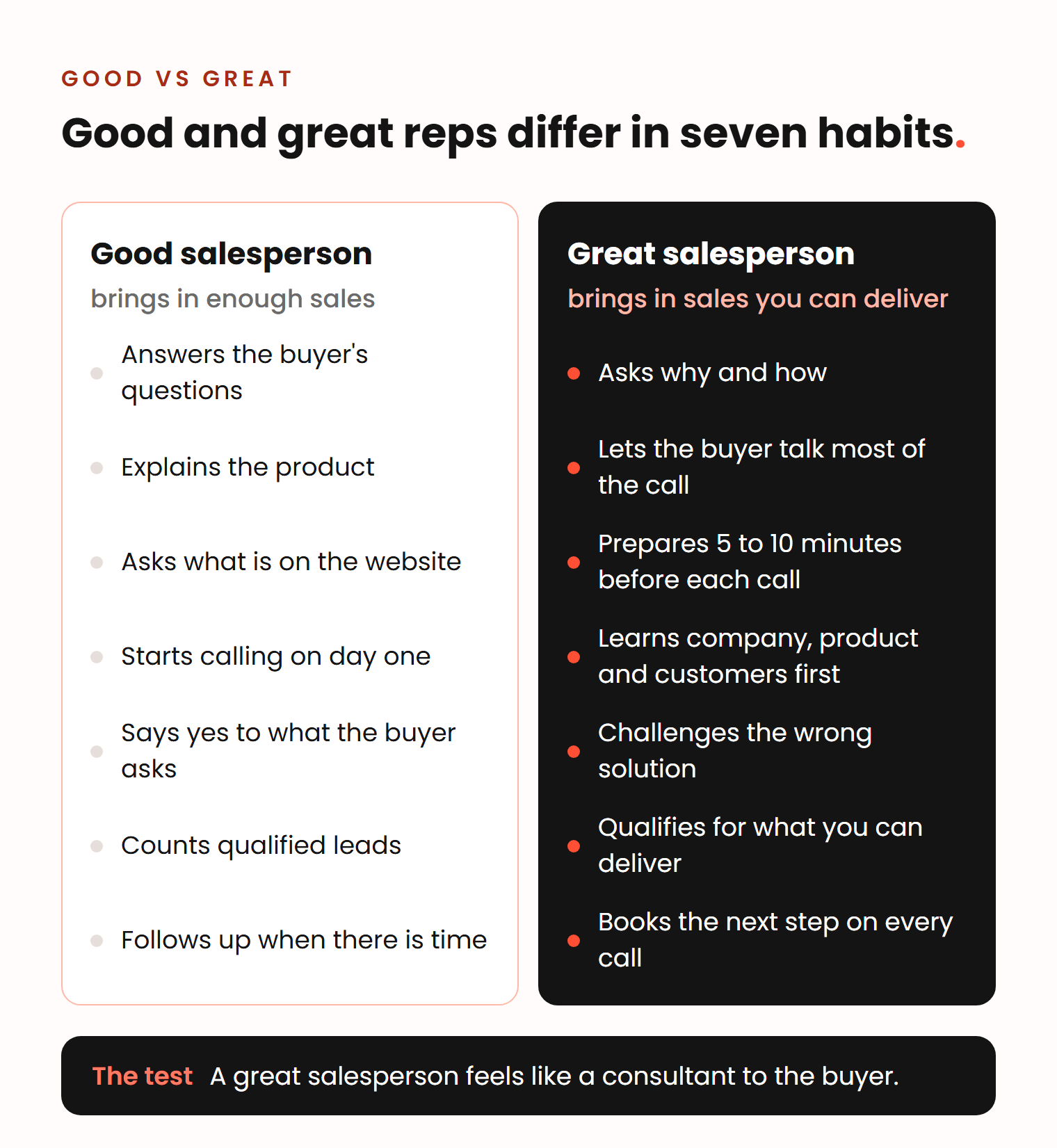
What makes a great salesperson shows on a single call: they ask more than they tell, they prepare before the meeting, and they speak up when the buyer is about to buy the wrong thing. They also sell only what the company can deliver, and they follow up every time. When Steve W. Martin gave personality tests to 1,000 B2B technology salespeople, 82% of the top performers scored extremely high on curiosity (Harvard Business Review, 2011).
Richie Dharma, head of HubSpot at Red Pandas Digital in Australia, started in sales at Deliveroo. He says he was not good at it, because he did not really believe in the product. His story points to a pattern: most of what makes a rep great is a set of habits a manager can see on a call, test in an interview and support with a process.
The traits below come from recorded conversations with Vladislav German, founder of Deeps Solutions, Benjamin Wallmann, partner at Deeps Solutions, Richie, and Robin Dijst, a HubSpot freelancer from the Netherlands.
Key takeaways
- Great salespeople ask why and how, and let the buyer talk for most of the call.
- They prepare for 5 to 10 minutes before every call and never ask what the website answers.
- They challenge a buyer who wants the wrong solution, and they qualify for what the company can deliver.
- Hire for the sales personality, then let the CRM carry the process: required fields, follow-up tasks and call recordings.
What is the difference between a good and a great salesperson?
A good salesperson brings in enough sales. A great one brings in sales the company can deliver well, and buyers trust them more because they act like an advisor.
Vlad describes a good rep as someone who knows the product, communicates well, follows up and builds relationships. A great rep also challenges the buyer instead of agreeing to everything. Ben adds the delivery side: the work after the sale starts with what the rep promised on the call. To him, a great salesperson feels like a consultant, which is the core of consultative selling.
The question is old. In 1964, David Mayer and Herbert M. Greenberg argued in Harvard Business Review that a good salesperson needs two qualities: empathy, the ability to feel as the buyer does, and ego drive, the personal need to make the sale (HBR). The traits below show what that looks like in a B2B team today.
What makes a great salesperson: the 7 traits
The seven traits are curiosity, listening, preparation, product knowledge, the nerve to challenge, honest qualification and consistent follow-up.
1. Curiosity: they ask why and how
If you can choose one trait, it would be curiosity, and it would be asking questions all the time. Everything should be asked: why are you doing that? How are you doing that?
Robin Dijst, HubSpot freelancer, Pack of Nodes
On the call: the rep asks why the buyer works the way they do, how the current process runs and what they want to achieve. These questions, Robin says, find the pain points and build trust.
In the interview: count the questions the candidate asks you. A curious candidate asks about your customers, why they buy and why deals are lost.
To build it: curiosity is hard to teach from zero, so hire for it. A fixed list of discovery questions gives every rep a floor.
2. Listening: the buyer talks most of the call
Instead of speaking too much, you need to start listening. This is the biggest thing that can differentiate a bad salesperson from a good one.
Vladislav German, founder of Deeps Solutions
On the call: Vlad’s framework has three parts: the buyer’s current state, the future state they want, and the gap between them. The rep interviews the buyer for most of the call to find that gap. Gong’s 2025 analysis of 326,000 sales calls points the same way: low performers talked 54% of the time in deals they won and 64% in deals they lost, while high performers kept about the same talk ratio either way (Gong).
In the interview: run a 15-minute mock discovery call where you play the buyer. Notice who talks more, and whether the candidate sums up your problem before they pitch.
To build it: record calls and review them together. Vlad’s warning: if nobody reviews the recordings and gives feedback, they are wasted time and money.
3. Preparation: they never ask what the website already says
On the call: the rep opens with what they already know and a guess about the buyer’s problem, so they lead the call. Ben names call prep as the habit that separates top performers. The buyer often talks to three to five companies and is tired of explaining the basics. His routine takes 5 to 10 minutes: the website, a short AI summary of the company, recent news, and the person’s LinkedIn posts from the last couple of weeks. Vlad’s rule: never ask what you could find online, such as headcount or revenue.
In the interview: the interview is a sales call too. A candidate who did not read your website first is unlikely to prepare for your buyers.
To build it: keep the history in one place. When every email, call note and past deal sits on the CRM record, prep takes minutes.
4. Product knowledge: they learn before they sell
On the call: the rep can advise across your options because they know which product fits which problem, and who it does not fit. Ben’s rule for a great rep in a new job: do not start calling on day one to prove the numbers. First learn the company, the products, and the customers and their needs. Otherwise the call turns into a list of features, and that rarely works.
Belief grows from the same knowledge, and Richie’s view is that consultative selling needs a rep who believes in what they sell. Vlad adds that product knowledge is the one part of a great rep you cannot hire. It builds over time inside your company.
In the interview: ask why a customer would buy your product, and who should not buy it.
To build it: plan the first weeks before the quota starts: recorded calls, won and lost deals in the CRM, calls with a senior rep. When the process lives inside the CRM, Ben adds, a new rep learns one tool instead of several.
5. The nerve to challenge: they do not agree with everything
On the call: Vlad’s example is a buyer who asks for one service when a different package would solve the problem. A good rep says yes. A great rep says the buyer needs the other package and explains why. Robin calls it boldness: being comfortable with uncomfortable questions, such as “what happens if you don’t go this route?”
The study behind the 2011 book The Challenger Sale found that nearly 40% of its high performers were Challengers, reps who teach the buyer and push back, while only 7% were Relationship Builders (Challenger Inc.).
Ben adds a condition: you can only challenge when you know more about solving the problem than the buyer does, so this trait depends on trait 4. The opposite failure is being too nice. Looking back, Richie would stop himself from being too nice and too open with clients, because once money is involved, they can use your words against you.
In the interview: in the mock call, ask for something that will not solve the problem you described. Does the candidate push back politely and offer a better option, or just agree?
To build it: Vlad believes this mindset can be trained once a rep stops seeing the job as serving and agreeing. Back reps when they redirect a deal, and use those calls in coaching.
6. Honest qualification: they sell what you can deliver
If I qualify 100% of my leads, that probably means I’m doing something wrong, because my fulfillment in the backend is going to have a real problem if I’m selling a service.
Benjamin Wallmann, partner at Deeps Solutions
On the call: the rep checks fit (needs, timeline, budget, who decides) and says early when something is outside what you do. Ben’s reasoning: delivery starts with the salesperson, because the rep answers the buyer’s questions and makes promises. A great rep may qualify fewer leads, but what they sell can be delivered, which leaves much less mess after the sale. He limits this to services. For a simple product, a high qualification rate is usually fine.
In the interview: ask about a deal the candidate walked away from, and why.
To build it: stop rewarding the qualified-lead count alone. Add exit criteria to each deal stage, a short handoff form at closed won, and track problems after the sale by rep.
7. Consistency: they follow up and book the next step
On the call: the rep ends every call with a booked next step. Robin sees the cost of skipping this in lost-deal data: a good call with no next step is, in his view, maybe the most painful mistake. Ben’s fix is to book the next call while you are still on the call, because few buyers are comfortable saying no to it.
Follow-up is first on Vlad’s list of simple things that win more deals. Many skip it because it feels like extra work and, without a CRM, nothing tracks it. Top performers, in his view, do these basics on time, however busy they are.
In the interview: watch what happens after it. Does the candidate send a short follow-up with a clear next step?
To build it: this is where the CRM carries the most. Require a next-step date before a deal can move, create follow-up tasks automatically, and use sequences for routine touches. For timing, see how many follow-ups to send and when to stop.
Should you hire for personality or for process?
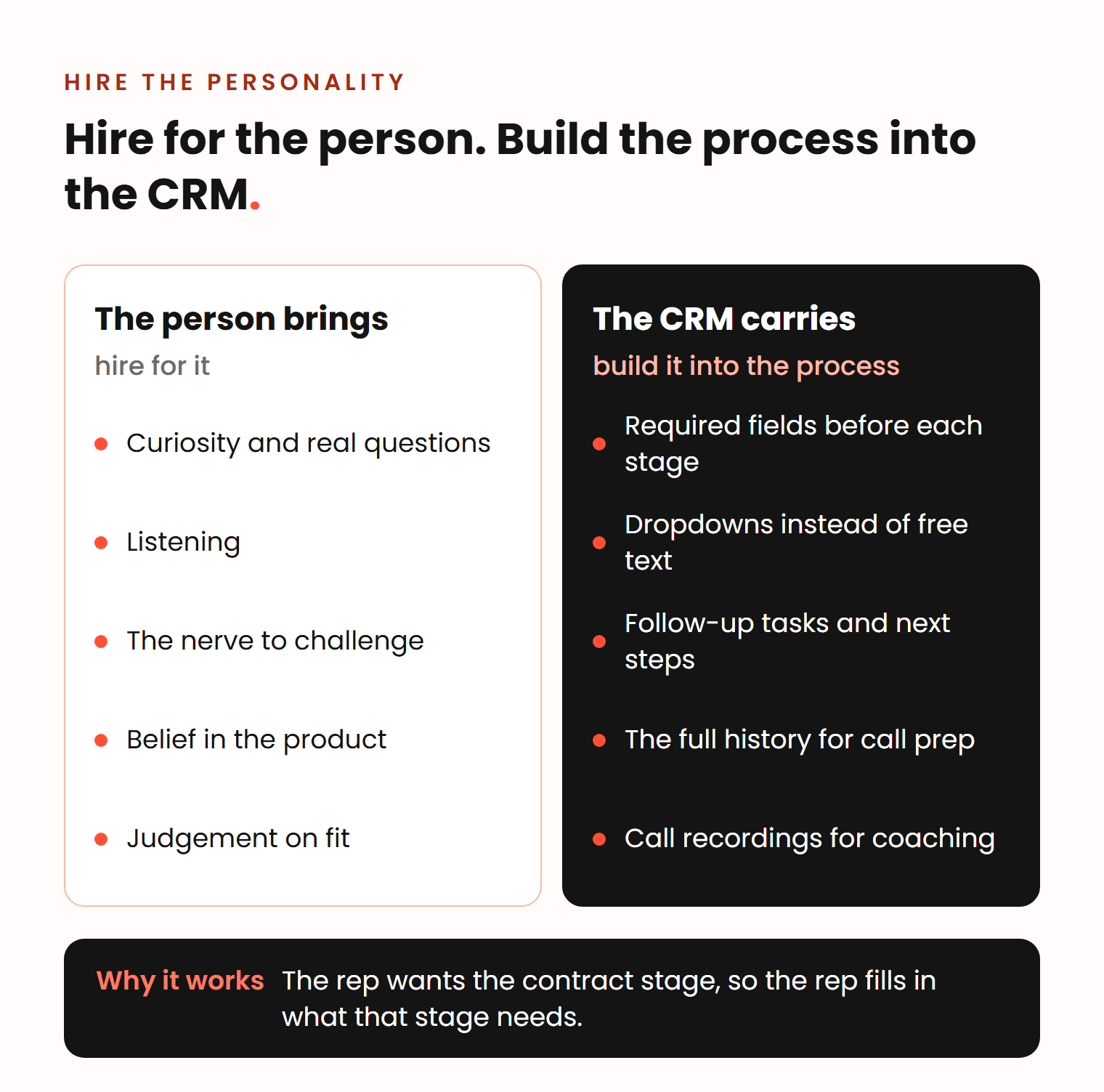
Hire for personality, then build the process into the CRM so the rep does not have to remember it. Turning a careful process-follower into a natural seller is much harder than giving a natural seller guardrails.
It’s way easier to get someone who has that salesperson personality, and then just give them a tool: okay, you have your guardrails here automatically, this is what we need, this is what we need to know, and this is how the process works.
Benjamin Wallmann, partner at Deeps Solutions
His example is the rep who sells well but leaves no notes. The fix is a deal stage the rep cannot enter until the required fields are filled. For the rep, sending the contract is the win, so the rep fills in what the contract stage needs. Dropdowns and pre-filled values instead of free text keep the data clean. In HubSpot, as of November 2026, conditional stage properties can make a field required before a record moves to a stage. Define the stages and exit criteria on paper first (see how to build a sales process).
Admin work takes time from selling. In Salesforce’s 2026 State of Sales survey of 4,050 sales professionals, the average seller spent only 40% of their time selling (Salesforce).
How Deeps helps sales teams with this
We are a HubSpot partner, so our part is the system around the rep. In sales process consultancy we map how your team sells and set exit criteria for each stage. Then we build the guardrails in HubSpot for your sales team: required fields per stage, follow-up tasks and a handoff to delivery. Team enablement and training trains reps, managers and admins by role and prepares one super user.
Frequently asked questions
What are the signs of a bad salesperson?
A bad salesperson talks more than they listen, joins calls unprepared and asks what the website already answers. They agree with everything the buyer says, promise what the company cannot deliver and send an offer before they understand the problem. Many good calls also die because the rep ends them with no next step.
Can you train someone to be a great salesperson?
Partly. Preparation, follow-up, product knowledge and a list of discovery questions can be taught and supported by the CRM. Curiosity and ease with people are harder to build, so hire for those. The nerve to challenge a buyer grows with experience and product knowledge.
How do you test a salesperson in an interview?
Run a short mock discovery call where you play the buyer, and ask for something that will not solve your problem. Check who talks more, whether the candidate prepared for the interview and whether they follow up after it. Ask about a deal they walked away from.
How do I become a great salesperson?
Start with the habits you control. Spend 10 minutes preparing before every call, ask why and how before you explain anything, and book the next step before the call ends. Learn your product and your customers well enough to tell a buyer when they are about to buy the wrong thing.