

Consultative selling is a way of selling in which the salesperson first diagnoses the buyer’s problem and only then recommends a solution, even when the best answer is a smaller order or a different product. The term comes from Mack Hanan’s book Consultative Selling, first published in 1970. It works best for complex B2B purchases with several options and several decision makers, and it is the wrong fit for simple, high-volume products.
Richie Dharma, head of HubSpot at the Australian agency Red Pandas Digital, started his career in sales and says he was not good at it, because he did not believe in the product. In a recorded conversation with Vladislav German, founder of Deeps Solutions, and Benjamin Wallmann, partner at Deeps Solutions, he described two schools of selling. One is push, push, push: scripts and a ready answer to every objection. The other is consultative: understand the pain points and why someone buys.
Key takeaways
- Consultative selling starts with the buyer’s goal and the gap to it, and the product comes last.
- A consultative seller sometimes recommends a smaller scope or another product, and that honesty builds trust.
- On a call, the difference shows in the opening, the questions, the challenge and the agreed next step.
- Solution selling, the Challenger Sale and insight selling belong to the same family, with more weight on the seller’s own point of view.
- For simple, high-volume products where the buyer already knows what they want, a fast transactional process works better.
What is consultative selling?
Consultative selling means the salesperson acts as an adviser. They learn how the buyer’s business works, find the real problem, and recommend what solves it. The product is the answer to a diagnosis, not the starting point.
Mack Hanan gave the method its name in his 1970 book. Sales writer Jack Malcolm sums up its core ideas: talk about what your product does for the customer, not what it is; understand the customer’s business; and grow your own profit by improving the customer’s profit. The book went through several new editions until 2004.
Ben’s definition is shorter:
A great salesperson doesn’t feel like a salesperson. It feels like a consultant that actually tries to get the best solution for the problem that you have.
Benjamin Wallmann, partner at Deeps Solutions
Robin Dijst, a HubSpot freelancer from the Netherlands, uses an idea from the book Building a StoryBrand. Many reps want to be the hero of the sales call. In consultative selling the roles flip:
The customer is the hero, and you’re just the guide, helping them to the next level.
Robin Dijst, HubSpot freelancer, Pack of Nodes
Consultative selling vs script selling
A script tells the rep what to say. Consultative selling tells the rep what to find out. In the script school Richie described, training is about lines: when the prospect says this, you answer with that. The aim is to get past every objection and close.
The problem shows up after the sale. Ben described the buyer who signed because the rep had an answer for every objection, and who realized two weeks later that it was not the right tool. A consultative rep asks what is best for the client, even if they do not sell it.
For me, a good salesperson tries to find the right solution for their clients. And sometimes the right solution isn’t your product.
Benjamin Wallmann, partner at Deeps Solutions
Ben added that this is easier when you have options. If all you sell is one mug in one color, there is little to advise on, so you push. With a range, like the beds and dinner tables he once sold, you can be a consultant inside your own catalogue.
Delivery matters too. When the same company sells and delivers, Richie said, the seller has every reason to promise only what the team can do.
What does a consultative B2B call sound like? An example
Here is a situation Richie described, shortened into two versions of the same call. A client’s sales manager for the APAC region wanted to drop the LinkedIn prospecting tool his reps used and replace it with HubSpot sequences, for internal reasons. Richie’s agency is a HubSpot partner, so the easy answer was yes. The lines below are a simplified reconstruction, not a transcript.
The script call
- Buyer: We want to replace our prospecting tool with HubSpot sequences.
- Rep: Good choice. Sequences can do that. We can switch you over next month.
- Buyer: Great, send me the offer.
The call is short. Then the reps notice the gap. As of November 2026, HubSpot describes sequences as a series of timed emails plus follow-up tasks for contacts you enroll. They do not find new people on LinkedIn, and that was the main reason the team bought the other tool.
The consultative call
- Rep: Before we talk about sequences, what did you buy your current tool for?
- Buyer: Our reps find people on LinkedIn, check the job title and add them to the CRM with one click.
- Rep: Which part do they use most?
- Buyer: That part. Finding and adding people.
- Rep: Then I would not switch. Sequences are good for follow-up, but they will not find people for you. I suggest we keep your tool, connect it to HubSpot properly and map its fields. I will still train your team on sequences for the follow-up.
That is close to what Richie did: he trained the team on sequences and recommended a better integration, instead of a tool not built for the job.
The consultative rep asked about the goal before the product, said no to a plan that would not reach it, and offered an alternative. Vlad calls this challenging the client: understand the problem, where the client wants to go and the gap between the two. If their plan will not get them there, say so, even if they should buy a different package. He described the effect with an image:
From a salesperson, you become a doctor. And once you are with a doctor, nobody argues: do I need this pill or not?
Vladislav German, founder of Deeps Solutions
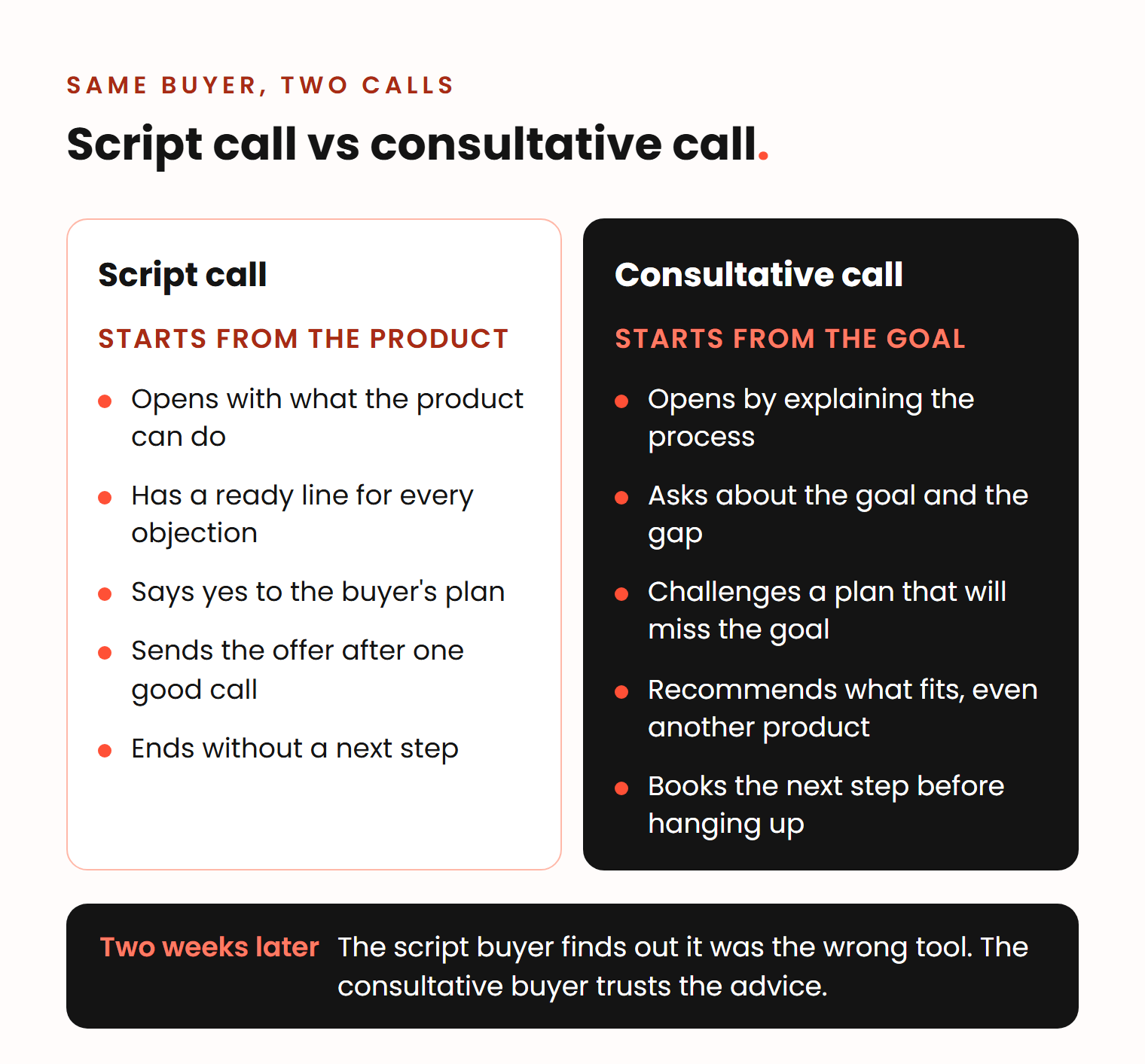
When Robin analyzes lost deals in the CRM, he sees two common mistakes: an offer sent after one good call in which the buyer only described their business, and a call that ends with no next step. His fix: tell the buyer your process at the start: today is discovery; if it makes sense for both sides, next time we go deeper into your problems; then we check the fit; only then do we make an offer. Before the call ends, book the next meeting. Our guide to sales follow-up covers what to do when you miss that moment.
How does it differ from solution selling, the Challenger Sale and insight selling?
These four names describe one family of methods. They differ in how strongly the seller leads with their own point of view.
| Method | Where it comes from | What the seller does |
|---|---|---|
| Consultative selling | Mack Hanan, 1970 | Diagnoses the buyer’s business and advises, even against their own product |
| Solution selling | Mike Bosworth’s company, 1983 | Starts from the buyer’s problem instead of the product, then shows how the product solves it |
| The Challenger Sale | Matthew Dixon and Brent Adamson, 2011 | Brings an insight about how the buyer can save or make money, and challenges their thinking |
| Insight selling | Mike Schultz and John Doerr, 2014 | Brings new ideas and helps the buyer make a better decision |
Solution selling became a named, problem-led method in the early 1980s. Mike Bosworth founded his training company in 1983, and his book Solution Selling followed in 1994.
The Challenger Sale moved the focus to the seller’s own view. Dixon and Adamson studied thousands of sales reps and sorted them into five profiles. Only one, the Challenger, delivered consistently high performance. In a 2012 Harvard Business Review article, The End of Solution Sales, Adamson, Dixon and Nick Toman argued that buyers can now define solutions for themselves, so asking about needs and matching a product is no longer enough.
Insight selling makes the same point from a different study. Schultz and Doerr analyzed more than 700 B2B purchases and compared the sellers who won with the ones who came second. The winners sold very differently.
Vlad’s great rep from our recordings belongs here too: one who challenges the buyer instead of saying yes to everything.
When is consultative selling the wrong approach?
Consultative selling is the wrong approach when the product is simple, the price is low and the buyer already knows what they want. A long discovery then costs the buyer time and the seller margin.
Research supports matching the method to the sale. Neil Rackham’s team studied more than 35,000 sales calls for the book SPIN Selling and found that many methods developed for selling low-value goods do not work for major sales.
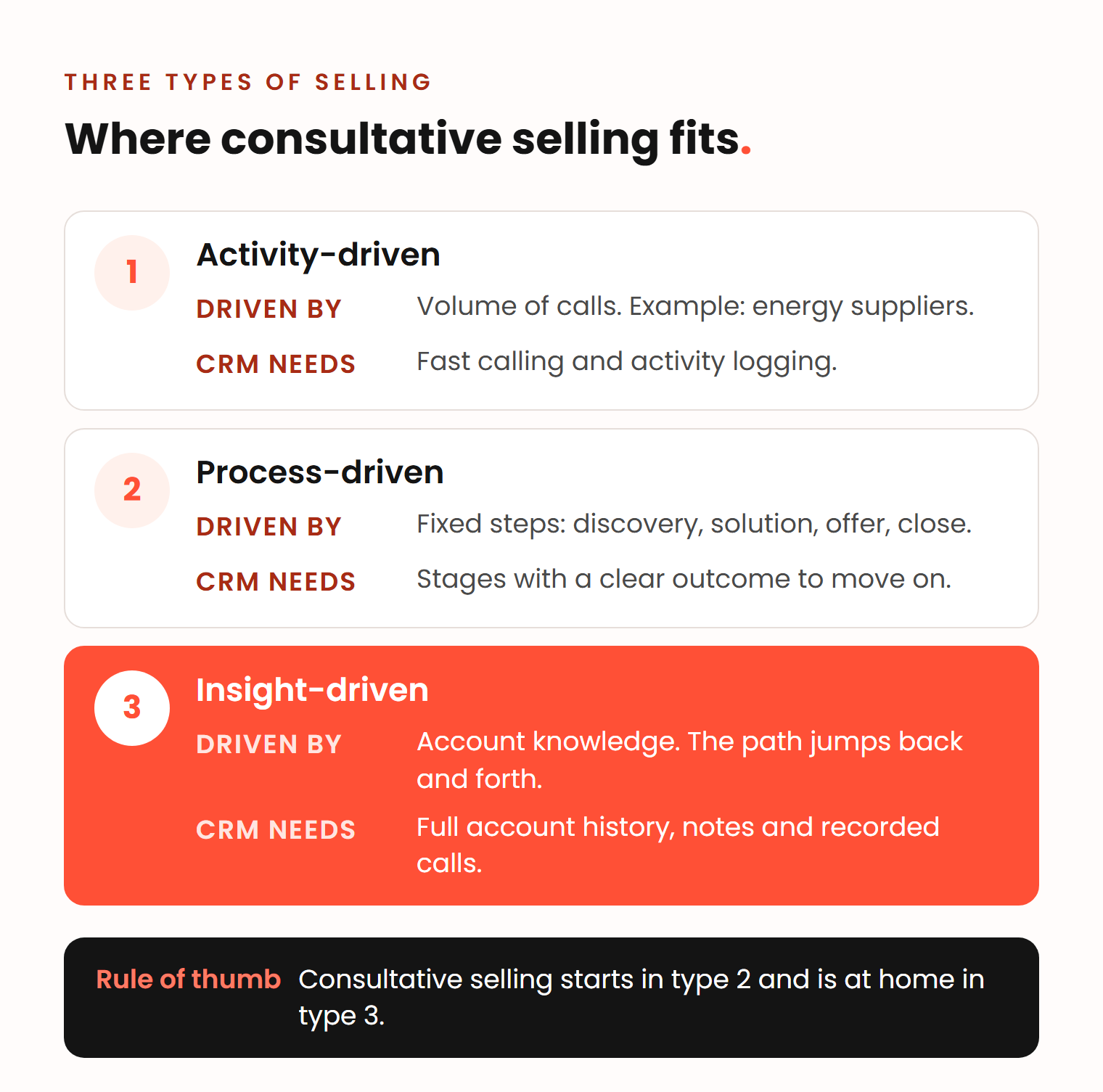
Robin sorts sales teams into three types, based on what he sees in their CRM data:
- Activity-driven. Volume decides. His example is energy suppliers that call as many people as they can.
- Process-driven. A fixed order of steps: discovery call, solution, offer, close.
- Insight-driven. Real account management. The path jumps back and forth, the reps tend to be senior, and the relationship matters most. Robin says a CRM is harder to set up here, and more valuable when done right.
A great rep in a service business may qualify fewer leads, Ben said, because they check whether the team can deliver. But if you sell a product and everyone who asks already knows what it does, a high qualification rate is usually fine.
Watch for two traps:
- A team without a process can look consultative. Ben noticed that such teams also jump back and forth between steps, like senior reps do, but only because nobody defined the steps. Start new reps on a clear process first. How to build a sales process shows how.
- Challenging needs knowledge. Ben’s condition: you can only challenge a client when you know more than they do about solving their problem. Vlad adds that it takes experience and the courage to contradict a client.
What are the steps of consultative selling?
There is no official list. Some guides use seven steps, such as this one from HawkSoft. Others use eight, such as Channel Insider’s. Here is the consultative sales process as it comes out of our recordings:
- Prepare. Spend 5 to 10 minutes on the buyer’s website, recent news and the person’s LinkedIn before the call.
- Explain your process. Tell the buyer that an offer comes after the fit is clear.
- Ask about the current state, the goal and the gap. Our sales discovery questions give you a full list.
- Challenge the plan if it will not reach the goal.
- Recommend what fits, even when it is a smaller scope or not your product.
- Agree on the next step before the call ends, and send the offer only when the fit is clear.
How we work at Deeps
Every Deeps project starts with an analysis of how the client’s team sells, before anything is built in HubSpot. You get a quote after an intro call, and complex projects start with a paid discovery that produces the HubSpot architecture and the project plan. When a client wants everything to live in HubSpot, we sometimes tell them which parts should not, and we build the parts that fit.
If your team wants to define its process first, Sales Process Consultancy maps how your team sells and designs the stages and exit criteria, from €1,500 in 2 to 4 weeks. What makes a great salesperson covers the traits behind this kind of selling.
Frequently asked questions
What is an example of consultative selling?
A client asked a HubSpot consultant to replace their LinkedIn prospecting tool with HubSpot sequences. The consultant asked what the team used the tool for and found that sequences would not do that job. He recommended keeping the tool and connecting it to HubSpot instead. The client kept what worked and still got training on sequences for the follow-up.
What are the 7 or 8 steps of consultative selling?
There is no standard list. Guides use different counts, often seven or eight steps, and most cover the same stages: prepare, build rapport, ask about needs and goals, agree on the problem, recommend, handle concerns, close and follow up. The order matters more than the count: diagnose first, recommend second.
Is consultative selling the same as solution selling?
They are close but not the same. Solution selling starts from the buyer’s problem and shows how your product solves it. Consultative selling is wider: the seller acts as an adviser and may recommend a smaller scope or a different product.
Who created consultative selling?
Mack Hanan named the method in his book Consultative Selling, first published in 1970. His core idea was to sell what the product does for the customer’s business, and to grow your own profit by improving the customer’s profit.