

Knowing how to build a sales process comes down to three things: write down how a deal moves from the first inquiry to a signed contract, give every pipeline stage an exit criterion that anyone can check, and decide what the first call must collect. Do this on paper with your sales team first, and build it in the CRM only after that. Then expect to change it as the team grows from 1 rep to 5 and then to 15.
Many teams skip the paper part. Benjamin Wallmann, partner at Deeps Solutions, described the usual picture when we talked about this in a recorded conversation. The founder sells: calls someone, asks some questions, books a follow-up call, then another one. Nothing is written down, so each new rep learns a slightly different version. This guide shows how to write the process down, which stages and exit criteria to use, and when the process has to change.
Key takeaways
- Define the sales process before you open the CRM, because tool settings pull the discussion away from how your customers buy.
- Every pipeline stage needs an exit criterion a manager can check, such as “proposal sent and review call booked”.
- The first call should collect everything the proposal needs, so deeper analysis happens in the paid project.
- The process breaks at two points: when the founder stops selling alone, and at around 5 reps, when each rep still owns the whole cycle.
- Keep it simple. Cover the main cases and skip a rule for every exception.
Why build the sales process on paper before the CRM?
Because the CRM should enforce the process, not design it. When a team designs inside the CRM, the talk turns to stage names, fields and automations, and nobody asks how the customer actually buys. Vladislav German, founder of Deeps Solutions, makes this the first rule:
The number one thing you should do when you think about your sales process is not to think about the tool you are going to use to enforce it.
Vladislav German, founder of Deeps Solutions
Keep the two discussions apart. Start at the beginning and talk it through with the people who sell:
- Through which channels do leads arrive?
- What happens after a lead arrives, step by step?
- Who does what at each step, and what does the customer do?
- Where are the gray areas, where each rep does it differently or nobody owns the step?
Ben’s tool for this is a digital whiteboard. You map the whole process, move steps around and try options before anything is built. A whiteboard costs nothing to change. A pipeline with reports, required fields and automations costs real hours to change. The result is your sales process documentation: one page the whole team can read.
Writing it down pays off. In a 2015 survey of 62 B2B companies, Jason Jordan and Robert Kelly found an 18% difference in revenue growth between companies that had defined a formal sales process and those that had not. The study is old and small, so read the number as a direction, not a promise.
How to build a sales process, step by step
Six steps take you from a blank whiteboard to a pipeline the team can follow:
- Map today’s process. List the lead channels, every step after a lead arrives, and the gray areas. Write down what happens now, not what should happen.
- Name the stages from the buyer’s side. A stage marks progress toward a purchase, such as “proposal sent”. It does not mark internal work, such as “waiting for the pricing team”.
- Write one exit criterion per stage. It is the event that moves the deal forward, and it must be visible in the record.
- Define the first call. List what you need to write a proposal, and plan to get it in one call.
- Tell the customer the process. Say at the start what happens next and when the offer comes.
- Build it in the CRM, then review it. Turn the exit criteria into required fields. After a few weeks, check where deals stall and adjust.
Which pipeline stages do you need, and what are exit criteria?
An exit criterion is the event that has to happen before a deal moves to the next stage. Without one, each rep moves deals on a feeling, and the pipeline report shows feelings instead of facts. Robin Dijst, a HubSpot freelancer from the Netherlands and a former Salesforce admin, described it this way:
A process is a really good guideline, because you can tell someone: if someone said “yes, I want an offer”, then you move it to the next stage. We can define basic outcomes in order to move to the next stage.
Robin Dijst, HubSpot freelancer at Pack of Nodes
Write each criterion as something a manager can check in the record:
| Vague exit criterion | Exit criterion you can check |
|---|---|
| We had a good call | The buyer named goals, a budget range and a timeline, and asked for a proposal |
| Proposal is done | Proposal sent and a review call booked |
| Deal looks likely | The decision maker confirmed scope and price |
| Contract stage | Contract signed by the person who can sign |
A simple B2B deal pipeline then looks like this:
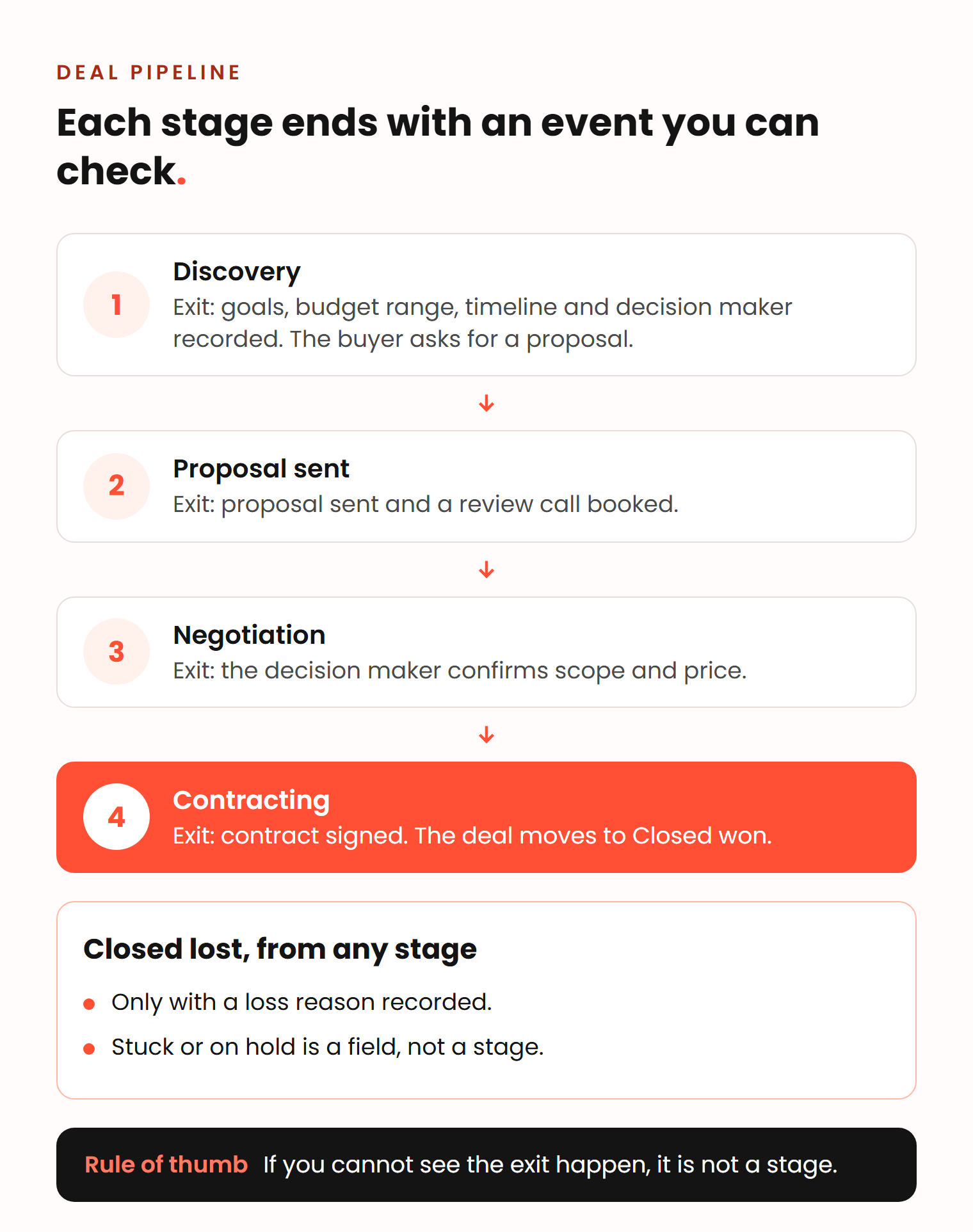
Three rules keep the stages clean:
- A status is not a stage. “Stuck”, “on hold” and “at risk” can happen at any stage. Track them in a field, so you still see where the deal stalled.
- One lost stage, with a reason. A required loss reason turns lost deals into data you can learn from.
- Work after the sale leaves the sales pipeline. Onboarding gets its own pipeline, so the sales board shows only deals a rep can act on.
What should you collect in the first call?
Everything you need to write the proposal. Ben’s rule is to know exactly what the proposal needs and get it in one call, or two if the deal is complex. Deeper analysis after that belongs in the paid project, not in the sales process, where nobody earns money yet.
For a B2B service or software sale, the list usually covers:
- Current situation: how they work today and which tools they use.
- Goal: what they want to change and how they will measure it.
- The gap: what goes wrong now and what it costs if nothing changes.
- Timeline: when they need it, and why then.
- Budget range: a range is enough at this point.
- Decision: who decides, who signs, and whether procurement or a security review is involved.
- Scope details: what your proposal needs, such as the number of users, integrations or data volume.
Give every rep the same list. Our guide to sales discovery questions has the full question set.
Then tell the customer what happens next. Robin’s advice: say at the start that today is a discovery call, that next time you go deeper into the problem, then you check the fit, and only then you send an offer. He sees the opposite in lost-deal analysis: reps send an offer after one good call, before anyone checked the fit.
The two views fit together. Collect what the proposal needs in the first call, and tell the buyer when the offer will come. For a simple deal, that is after one call. For a complex one, it may be after two or three.
End every call with the next meeting booked. In Ben’s experience, buyers rarely feel comfortable saying no to a follow-up while you are still on the call.
How does the sales process change as the team grows?
The process has to change at two points: when the founder stops selling alone, and at around 5 reps. Getting these two moments right is most of how to scale a sales team without hiring faster than you can onboard.
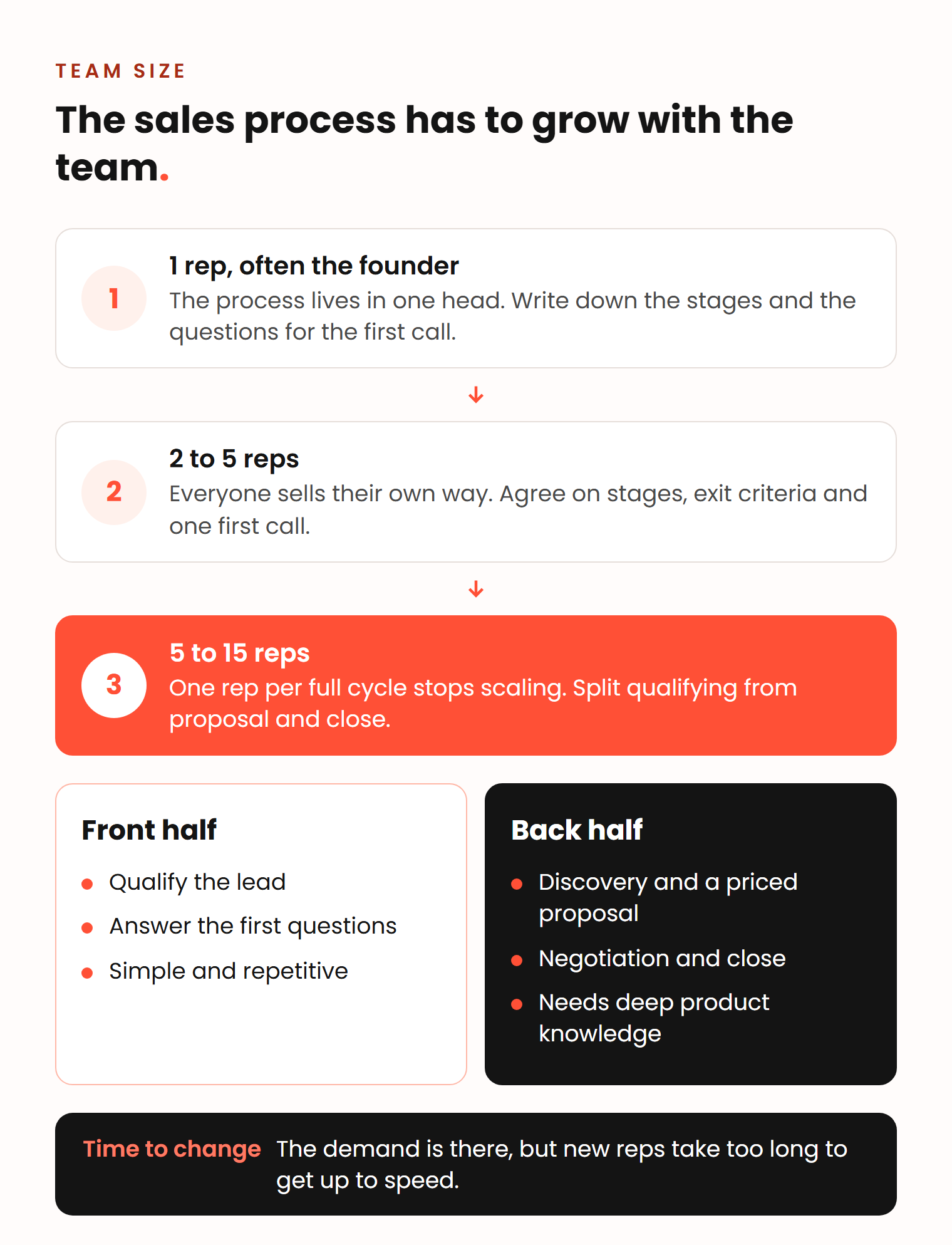
1 rep. Often the founder. The process lives in one head and works because one person remembers everything. Write the stages and the first-call questions down now. It is the only way the second rep learns the same process.
2 to 5 reps. Ben sees this as the step where teams most often have no real process. Each rep calls, asks some questions and books one follow-up after another. The fix is to agree on the stages, the exit criteria and one first call that collects what the proposal needs.
5 to 15 reps. Vlad described the next break. Each rep still owns the whole cycle, from the new lead to the signed contract. The front half is simple and repetitive: qualify the lead and answer the first questions. The back half needs deep product knowledge and a priced proposal. So new reps take a long time to onboard, while experienced reps spend their hours on the simple front half. The clearest sign: you have the demand, but you cannot add reps fast enough.
The fix is a different sales team structure. One role qualifies new leads. Another runs discovery, the proposal and the close. In the CRM, this shows up as a lead pipeline in front of the deal pipeline.
You do not need a full diagnosis before you act:
If it seems to you that you have to change something in your process, it is probably true.
Vladislav German, founder of Deeps Solutions
A bottleneck you can feel is usually real, even before you know the fix.
How do you put the sales process into the CRM?
Turn each part of the paper process into one CRM setting. In HubSpot, as of November 2026, it maps like this:
| On paper | In HubSpot |
|---|---|
| Front half: new inquiry to qualified | Lead pipeline. The default has five stages: New, Attempting, Connected, Qualified, Disqualified |
| Back half: discovery to signed contract | Deal pipeline. The default has seven stages, from Appointment scheduled to Closed won and Closed lost. Rename them to your own stages |
| Exit criteria | Stage properties set to required, so nobody can move a deal into the stage until the field has a value |
| Fixed order of stages | Pipeline rules that stop users from skipping stages or moving deals backwards (Professional and Enterprise) |
| Loss reasons | A required reason field on Closed lost |
Start with few required fields. Each one costs the rep time on every deal, so ask only for data you will use in a report or a decision. Ben put the balance well:
You don’t need a contingency for every little thing that could happen, but you should have the main cases in a process that you can just go through, and your salespeople know what to do.
Benjamin Wallmann, partner at Deeps Solutions
When we merged Apifonica’s two HubSpot portals into one, we started with workshops and a CRM architecture plan. Then we built a new lead pipeline, a revised deal pipeline with required fields at each step, and a clear handover to the implementation team.
How Deeps helps
Every project starts with an analysis of how your team sells. In Sales Process Consultancy, we interview your team, map the current process and design the stages, exit criteria, handoffs and reporting. It takes 2 to 4 weeks, from €1,500. If you want it built, HubSpot Implementation turns the design into pipelines, required fields and automations. See HubSpot for sales teams for what the setup covers.
Frequently asked questions
What are the seven steps of the sales process?
The textbook model lists prospecting, preparation, approach, presentation, handling objections, closing and follow-up. It describes what the rep does, not what the buyer does. Use it as a checklist for rep skills, and build your pipeline from stages the buyer passes through.
How many stages should a sales pipeline have?
Fewer than most teams think. A direct B2B sale often needs four open stages: discovery, proposal sent, negotiation and contracting, plus Closed won and Closed lost. If a stage has no exit criterion you can check, merge it with the next one.
How do you make sales consistently?
Prepare before each call, listen more than you talk, and follow up every time. Vlad named these three habits as the simple things that win more deals. A written process makes them repeatable, because every rep follows the same steps and you can see in the CRM where deals stall.
When should you change your sales process?
When you feel a bottleneck, when new reps take months to become productive while demand waits, or when your pipeline report cannot show where deals stall. Change one part at a time, explain the reason to the team, and check the effect in your reports after a few weeks.