

Good sales discovery questions collect what you need to write the proposal: the client’s current state, the future state they want, the gap between the two, budget and timeline, and how they will decide. Fifteen questions in those five groups cover it, and 10 minutes of research before the call removes the ones you could have looked up.
A list of 46 questions does not help on a real call. In Gong’s analysis of 519,000 recorded discovery calls, asking 11 to 14 questions correlated with the greatest success.
Vladislav German, founder of Deeps Solutions, runs his intro calls this way. He keeps a fixed list of questions, records the call, and gives the transcript to a Claude skill that drafts the proposal. When we talked about it in a recorded conversation, he said a simpler proposal now takes him 5 to 10 minutes instead of hours of work after the call. That AI proposal workflow only works because the questions came first.
Key takeaways
- A discovery call has one job: collect what you need for the proposal, in one call, or two if the project is complex.
- Group your questions by what the proposal needs: current state, future state, the gap, budget and timeline, and the decision process.
- Spend 10 minutes before the call on the website, an AI summary, the news and the person’s LinkedIn, so you never ask what you could have looked up.
- Ask fewer, better questions: Gong’s data links 11 to 14 questions to the most successful discovery calls, and senior buyers want even fewer.
- Make sure the client says the key answers out loud, so they land in the recording and the transcript.
What is a sales discovery call for?
A discovery call is for learning enough to propose the right thing. Benjamin Wallmann, partner at Deeps Solutions, puts the rule simply: know exactly what you need to build a proposal, and get it in one call, or two if the project is complex. Calls that dig deeper after that belong to the paid project, not to a sales process where nobody earns money yet.
Many reps think their job on the call is to explain the product. Vlad disagrees. The job is to understand the client’s problem: where they are today, where they want to be, and the gap between the two. Your product or service closes that gap, or part of it.
Your goal is to interview the person most of the call. It comes back to listening. Your goal as a salesperson on the call is to listen, and to help the client understand his problem.
Vladislav German, founder of Deeps Solutions
Robin Dijst, a HubSpot freelancer from the Netherlands and a former Salesforce admin, describes the same idea with a lesson from Donald Miller’s book Building a StoryBrand. Many reps want to be the hero of the call and push for the sale. He turns it around:
So the customer is the hero, and you’re just the guide, helping them to the next level.
Robin Dijst, HubSpot freelancer from the Netherlands
That is the core of consultative selling: ask until you understand the problem, then show how to solve it.
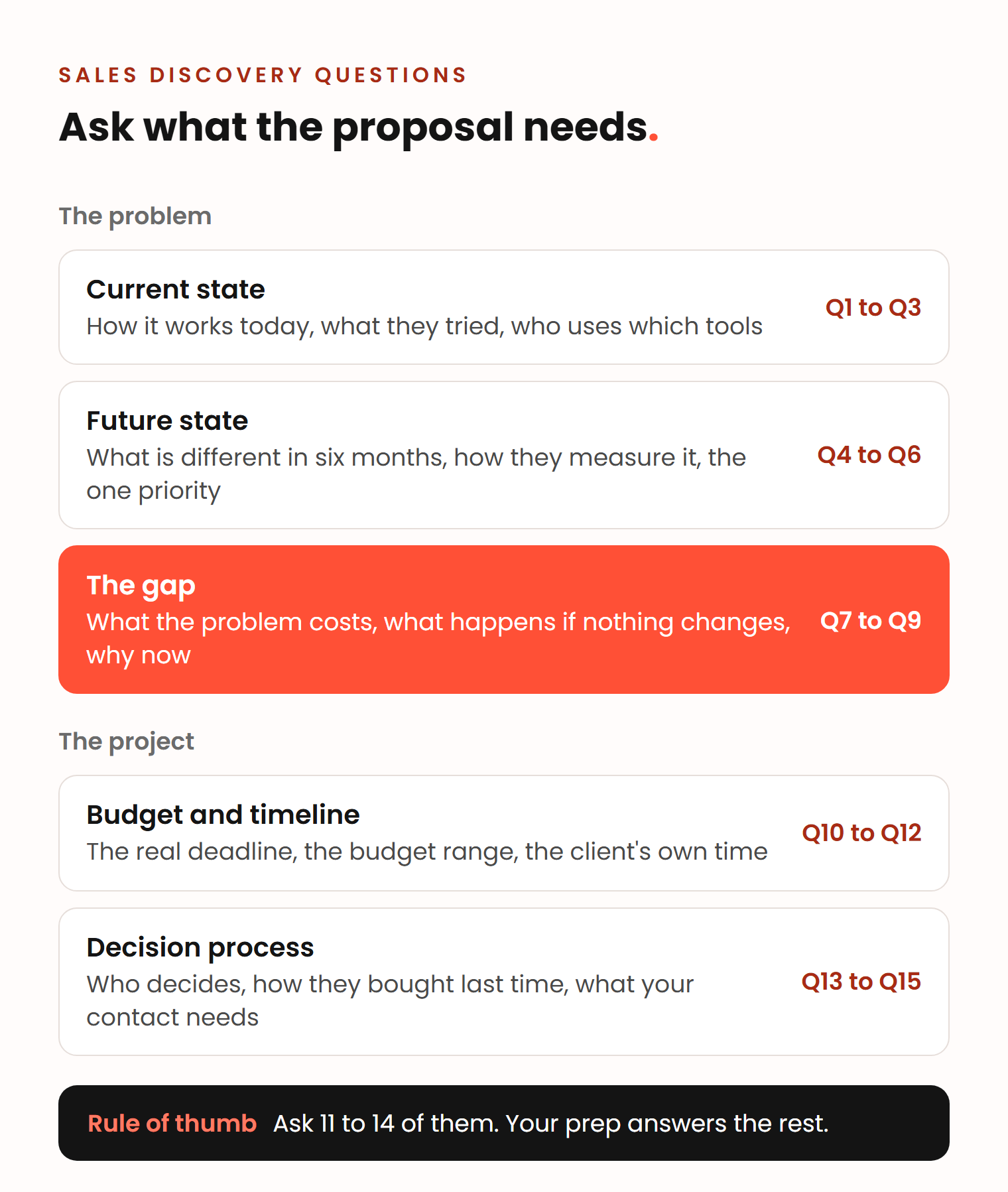
The 15 sales discovery questions, grouped by what the proposal needs
Each group of questions fills one part of your proposal. Use your own words and follow the conversation, not the order of the list. Gong found that top sellers spread their questions evenly through the call, while average reps ask most of them at the start.
Current state: how does it work today?
- “Walk me through how this works today, step by step.” You hear the process in the client’s words. The vague parts of the story are usually where the problem sits.
- “What have you already tried, and what happened?” This tells you what not to propose, and how much patience the client has left.
- “Who works on this every day, and which tools do they use?” The number of people and systems sets the size of the scope, and so the price.
Future state: where do you want to be?
- “If this works, what is different in six months?” The answer becomes the goals section of your proposal, in the client’s own words.
- “How will you know it worked?” This gives you success criteria to write into the proposal and to report on later.
- “If you could fix only one thing, which would it be?” This shows the priority, so you can split the proposal into phases.
The gap: why does it matter now?
- “What does this problem cost you today, in time, money or lost deals?” This puts a value on the gap. A price is easier to accept next to a cost the client named.
- “What happens if you don’t change anything this year?” Robin counts this among the uncomfortable questions a good rep should be willing to ask. It tests whether the project is urgent or only nice to have.
- “Why now? What made you look for help this month?” The trigger is often the real reason, and it is rarely the first thing the client says.
Ben’s view is that the simplest way to sell is to show the client the pain and let them figure it out themselves. A few well-placed questions, and the client sees the problem before you name your product. Vlad compares it to a visit to the doctor: once you diagnose instead of sell, nobody argues about whether they need the pill.
Budget and timeline: what is realistic?
These overlap with classic sales qualification questions, but here they serve the proposal, not a scorecard.
- “Is there a date this has to work by, and what drives that date?” This separates a real deadline, such as a contract renewal or new hires starting, from a wish.
- “Do you have a budget range in mind, so I can propose the right scope?” Without a range you guess the scope. With one, you can offer a version that fits, or say early that nothing does.
- “Who on your side will have time for this, and how much?” Projects stall when the client’s team has no time. This answer shapes the timeline more than your own capacity does.
Decision process: how will you decide?
- “Who else will be part of the decision?” In the mid-market companies we work with, a finance or operations lead often approves the budget and IT often reviews the tools. The proposal has to answer their questions too.
- “How did you buy something similar last time?” This shows the real process: procurement, security review, legal, and how long each step took.
- “What do you need from me to take this to them?” Your contact usually has to sell the project inside the company. Give them what they need to do it.
How many discovery questions should you ask?
Plan for 11 to 14 on a typical discovery call, and fewer with senior executives. In Gong’s data, asking more than 14 questions brought success rates back to average.
With executives the number drops further. Gong found that successful meetings with C-suite executives had four questions on average, and unsuccessful ones had eight. Senior people often sit through several discovery calls with other sellers before yours. Gong calls this discovery fatigue.
So treat the 15 questions as a bank, not a script. Your prep answers some of them, and the client answers others before you ask. Vlad does not read his list out loud. He keeps it in mind and makes sure the client says the important answers in their own words:
Even if I have an idea about them, I still want the customer to talk me through those things: their goals, their pain points, their timeline. It is important for them to say this on the call, so that it appears on the recording and I have it on the transcript.
Vladislav German, founder of Deeps Solutions
How do you prepare for a sales call in 10 minutes?
Spend 5 to 10 minutes on four sources before every call: the client’s website, an AI summary of the company, recent news, and the person’s LinkedIn posts from the last few weeks. This is Ben’s routine, and he sees it as the habit that separates top performers from the rest:
So I think the biggest thing is a top performer preps for every call. Way too many sales reps go into a first call with a client and they know absolutely nothing about the client.
Benjamin Wallmann, partner at Deeps Solutions
His reason: the client is often talking to three to five companies. If you ask the same basic questions as everyone else, you make them explain everything again. Prep gives you rapport, a first guess at their problems, and the chance to lead the call instead of following it.
Research on sales questions points the same way. Neil Rackham’s SPIN Selling research studied more than 35,000 sales calls. Situation questions, the ones about plain facts, were slightly negatively linked to success. In a 2020 video for Huthwaite International, Rackham said the effect is stronger today: buyers expect you to research those facts yourself, and they get impatient when you ask.
Vlad’s rule for pre-call planning is concrete. Do not ask what the company does, how many people work there or what its revenue is. Check it before the call, and spend the call on what you could not find online.
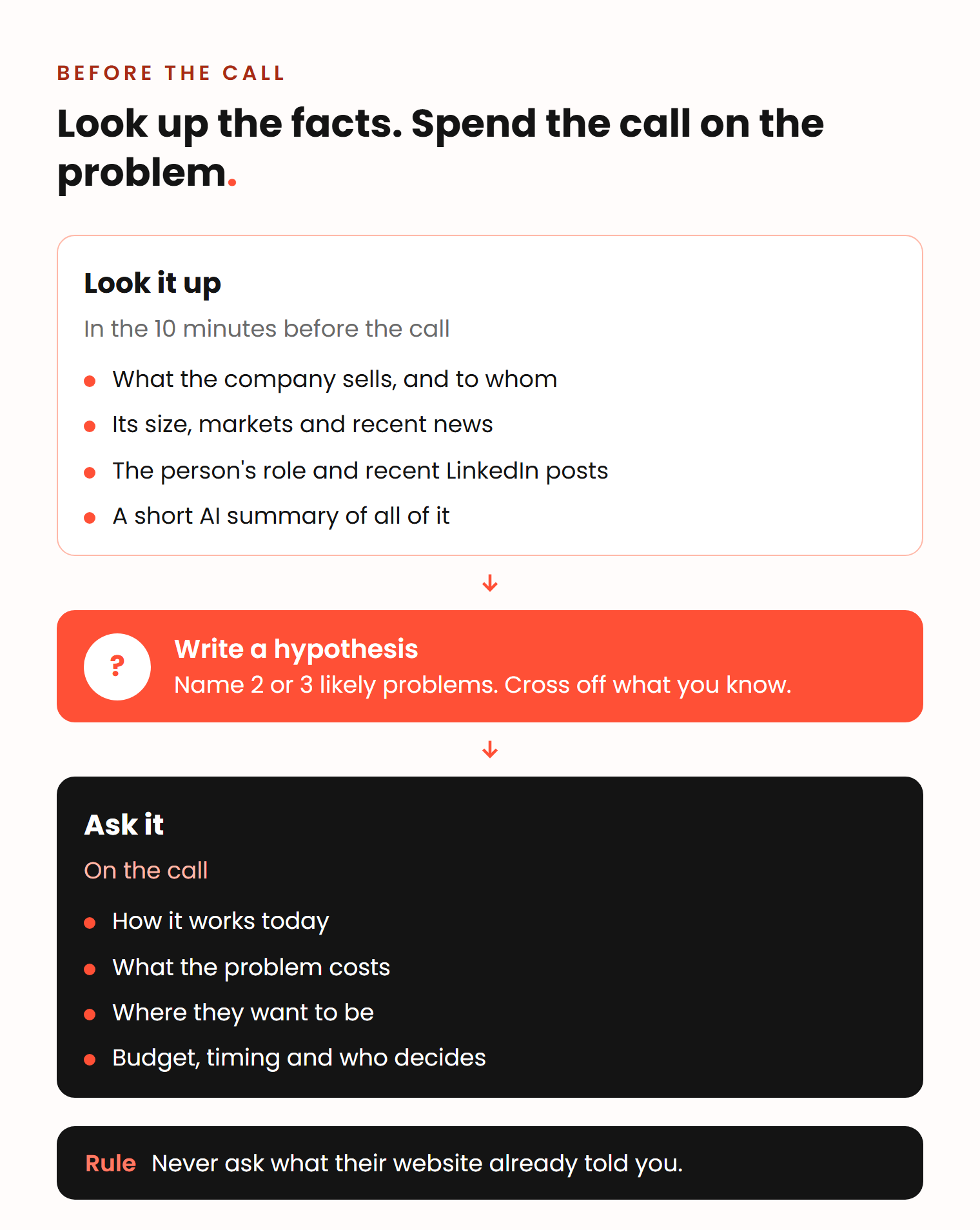
End your prep with a hypothesis. Write down the two or three problems you expect, and cross off every question you can already answer.
How do you end a discovery call?
Summarize what you heard, agree on the next step, and book it before you hang up. When Robin analyses why deals did not close, he sees two mistakes again and again. The first is the offer that comes too early: the rep had a great first call and sends an offer, but the client only described their business, and the fit was never checked. The second, and in his view possibly the most painful, is a good call that ends with no next step.
Ben’s fix is simple: book the next meeting while you are still on the call. It is much easier there, and people rarely feel comfortable saying no. Robin adds one habit: tell the client your process at the start, so they know whether today ends with an offer or with a deeper second call. Our guide to sales follow-up covers what happens after that.
This is also the honest limit of the one-call proposal. If the call did not answer the gap, budget and decision questions, send a summary and book a second call, not an offer.
How we run discovery at Deeps
Every Deeps project starts with analysis of how the team sells. Our intro calls follow a fixed list of questions, and you get a quote after the call. Complex projects start with a paid discovery, because the deeper questions take real work.
When a sales team wants its own discovery questions, stage exit criteria and proposal workflow, we build them in a Sales Process Consultancy project, from €1,500 and 2 to 4 weeks. To see where discovery fits in the wider process, read how to build a sales process.
Frequently asked questions
Can you give me an example of a discovery question?
“Walk me through how this works today, step by step.” It is open, it gets the client talking about their current state, and the vague parts of the answer show you where the problem is. A good follow-up is “What does that cost you today?”
What questions should you ask in sales?
Ask the questions your proposal needs answered: how things work today, where the client wants to be, what the gap costs, the budget and timeline, and who decides. Skip anything you could have found on their website or LinkedIn before the call.
What are 5 open-ended questions for a sales call?
- Walk me through how this works today.
- What have you already tried, and what happened?
- If this works, what is different in six months?
- What happens if you don’t change anything this year?
- Who else will be part of the decision?
Should you send a proposal after the first call?
Yes, if the call answered all five groups of questions. If the client only described their business, the offer comes too early, so send a summary and book a second call. Large or complex projects often need a paid discovery before a fixed proposal.