

CRM ROI is the gain from a CRM minus its full cost, divided by the full cost. The licence is the part you see on the quote, but the larger cost is your team’s time for training, process change and admin. Measure the return against 2 to 3 goals you set before you buy, and expect the first year to carry most of the cost.
Vladislav German, founder of Deeps Solutions, gives a simple example of a tool that works and still wastes money. A manager tells every rep to record their calls, to keep control and to hear what reps tell customers. The transcripts pile up. Nobody has the time or a system to review them and give the reps feedback. The company paid for the tool and the team’s time, and got nothing back.
A CRM carries the same risk at a larger scale. To avoid it, count the full cost and decide before you buy what the CRM must change.
Key takeaways
- CRM ROI is the gain minus the full cost, divided by the full cost. Count gross profit, not revenue, and name the period.
- The licence is the visible cost. Training, process change and admin time are paid in your team’s hours and often cost more.
- Set 2 to 3 measurable goals before you buy, and record your starting point before go-live.
- The first year carries the one-time costs, so look at year one and year two separately.
- A team that is still frustrated with the CRM months after go-live is a strong sign it is not paying back.
What is CRM ROI and how do you calculate it?
CRM ROI is what a CRM brings in or saves, minus what it costs, divided by what it costs. It is the standard return on investment formula:
CRM ROI = (gain from the CRM minus full cost of the CRM) divided by full cost of the CRM, times 100
The hard part is deciding what goes into it. Three rules keep the number honest:
- Count gross profit, not revenue. A won deal worth €15,000 at a 40% margin adds €6,000 to the gain, not €15,000.
- Count the full cost, including your team’s hours. The Corporate Finance Institute warns that an ROI result depends on which costs you include, and that a true ROI accounts for all of them.
- Name the period. The basic formula does not account for time (same source). A 20% return in one year and a 20% return over five years are very different results.
Count saved time as money only if it goes somewhere: more sales calls, a report nobody has to build, or a hire you no longer need. And never count the same gain twice.
What does a CRM really cost?
A CRM costs the licence plus everything your team spends to make it work: implementation, training, process change, admin time, integrations and data cleanup. Together these make up the CRM total cost of ownership. Most of them never appear on the vendor’s quote.
When we talked about how to judge a new sales tool, Benjamin Wallmann, partner at Deeps Solutions, started with the costs nobody writes down.
The cost that everyone sees is how much the subscription costs and how much the implementation costs. But you have a way bigger cost than that. All your salespeople need to be trained. Your processes change.
Benjamin Wallmann, partner at Deeps Solutions
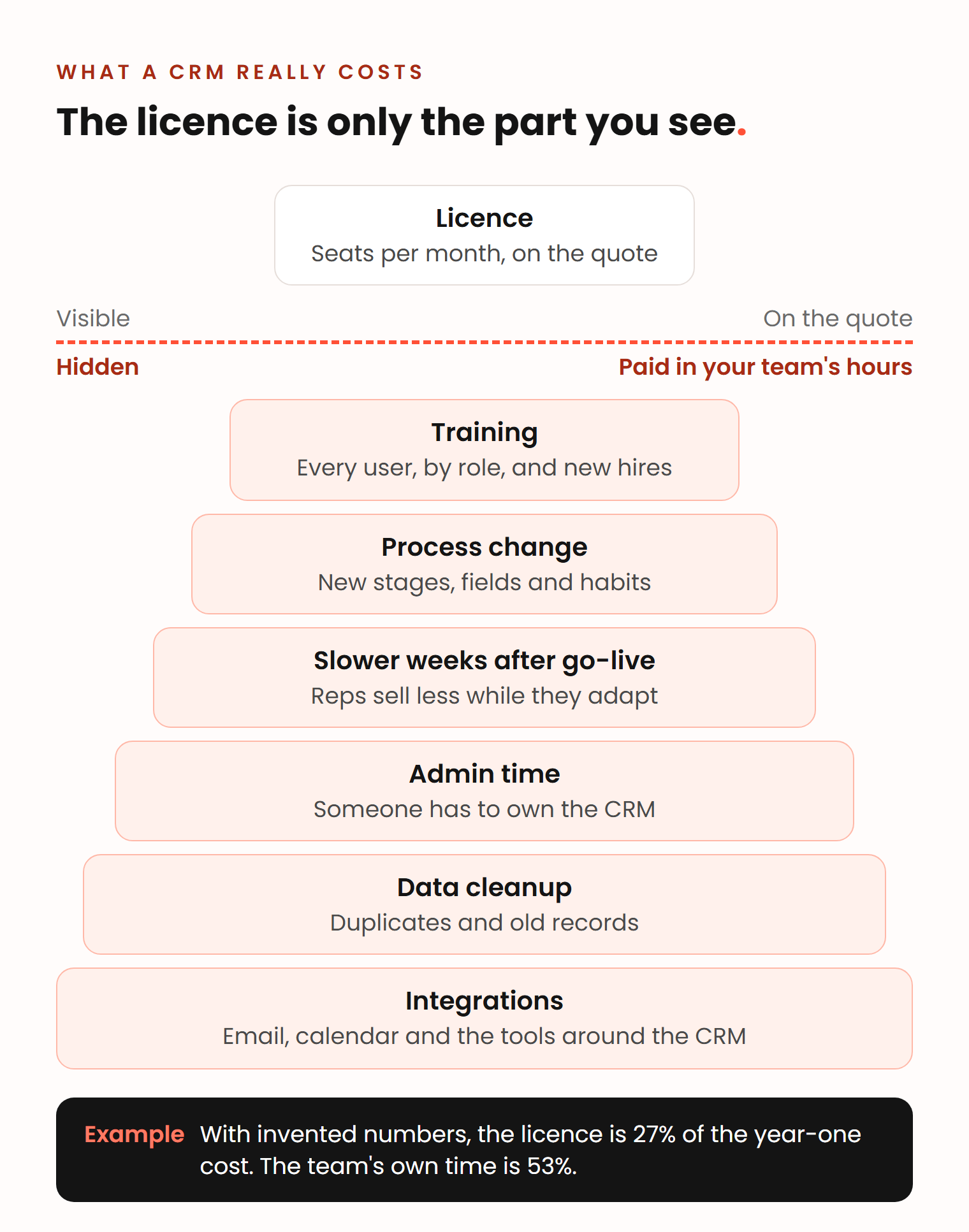
What to put in the cost column:
- Licence. Seats per month, sometimes plus a one-time fee. HubSpot, for example, lists a required $1,500 onboarding fee for Sales Hub Professional on top of the seats (HubSpot pricing, as of November 2026). Which HubSpot plan do we need? helps you avoid paying for a tier you do not use.
- Implementation. The partner or internal team that builds the setup. See what a HubSpot implementation costs for what drives the CRM implementation cost.
- Your project team’s time. Workshops, decisions and testing. How involved does our team need to be? shows the roles.
- Training. Every user, by role, and every new hire later.
- Process change. New stages, fields and habits. Reps sell a little less while they adapt.
- Admin time. Someone has to own the CRM after go-live.
- Integrations and data cleanup. Email, calendar and other tools, plus duplicates and old records.
Robin Dijst, a HubSpot freelancer from the Netherlands and a former Salesforce admin, makes the same point about admin.
It can be a cheap CRM to start using. But if you don’t have someone that can make use of it, then it’s still a very expensive line item.
Robin Dijst, HubSpot freelancer and former Salesforce admin
Robin also raised a newer cost risk: AI features paid by use, not by seat, so the bill grows with usage. HubSpot, for example, charges some AI features, such as its Customer Agent and Prospecting Agent, in HubSpot Credits. Each plan includes a monthly amount. When it runs out, those features pause unless you buy more (HubSpot Knowledge Base, as of November 2026). Budget for usage and check it after the first months.
Ben adds a rule for the buying decision: know what you need the tool for. A large tool can create more work than a smaller one that does the one thing you need. See how to choose a CRM.
How do you measure the return? Set 2 to 3 goals before you buy
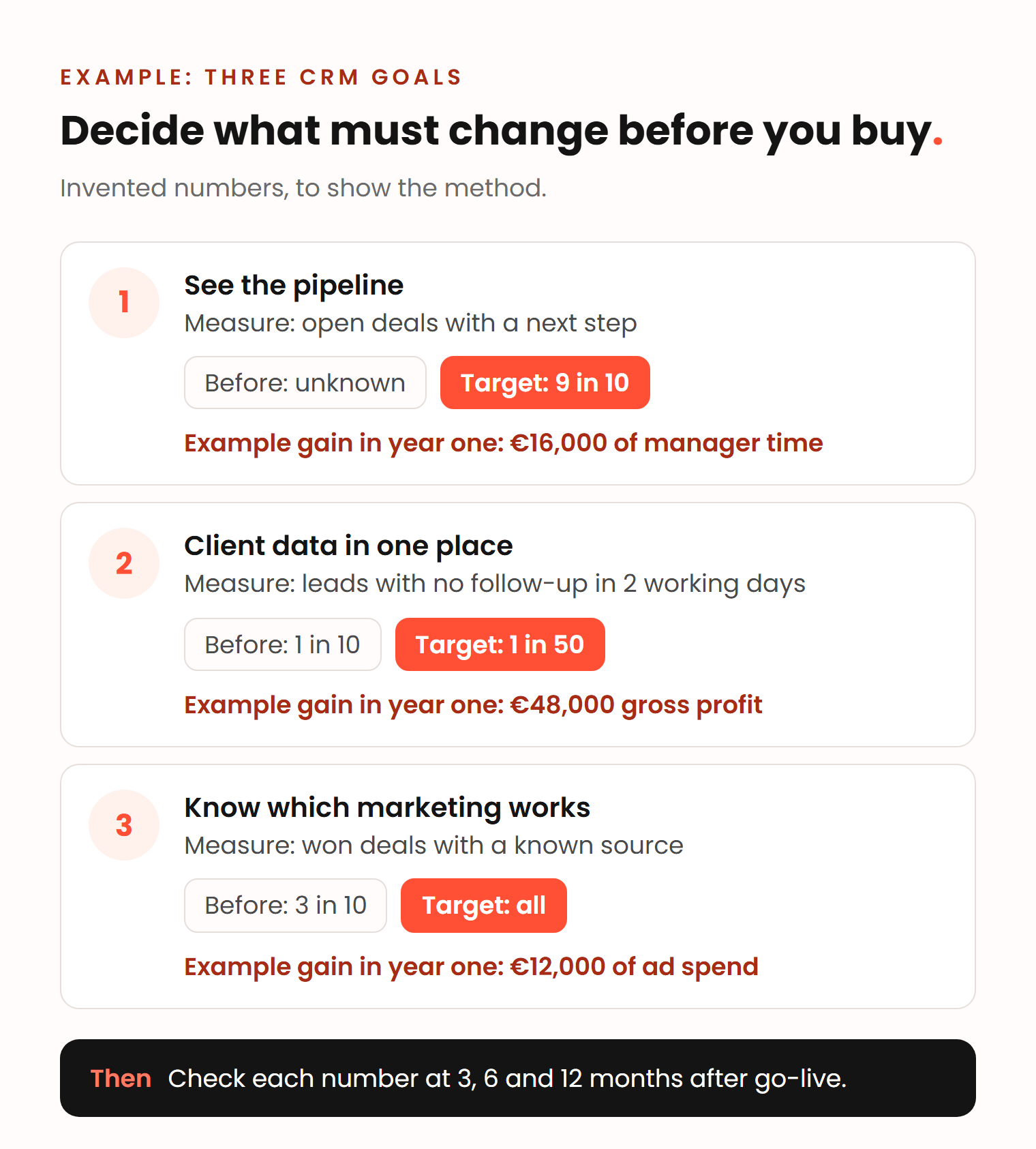
Measure the return against 2 to 3 goals you write down before you buy, each with a number you can track. Without them, you can only judge the CRM by how it feels, and a new system rarely feels good in the first weeks.
Ben’s first test is how the team feels. If people are frustrated with the tool, “that’s a really good sign that it’s not bringing value”, even when it technically works. Vlad did not fully agree. A new system does not always feel easier, he said, especially during the transition, when frustration is normal. His alternative is to set goals up front. For a CRM, his three were:
- Start to see the data.
- Store client data in one place, not only in the heads of the salespeople.
- Understand which marketing works and which does not.
The project will take a lot of team time and probably an implementation partner. That is acceptable if the goals are met.
If, as a result of it, in a few months you achieve those three goals and you can start to measure and grow your company, that’s a good decision.
Vladislav German, founder of Deeps Solutions
The first goal matters most to managers. Vlad heard a similar request from many early clients: an owner with five salespeople sees one sell five times more than another, and does not know why. A CRM shows each rep’s conversion rate and where deals drop out.
Give each goal a number, record it before go-live, and check it again at 3, 6 and 12 months.
A worked example: CRM ROI for a 12-person sales team
The numbers below are invented to show the method. They do not come from a client project and they are not a benchmark. Replace them with your own.
The example company sells B2B services. It has 12 reps and 2 sales managers, so 14 paid seats. Every hour of staff time is valued at €50, which includes salary and overhead. Go-live is after about 12 weeks, which leaves 40 working weeks in year one.
Year-one costs (example)
| Cost item | How it is counted | Year one |
|---|---|---|
| Licences | 14 seats × €100 per month × 12 months | €16,800 |
| Implementation partner | Fixed project price | €10,000 |
| Training | 14 people × 12 hours × €50 | €8,400 |
| Slower weeks after go-live | 12 reps × 2 hours a week × 8 weeks × €50 | €9,600 |
| Project owner, super user and managers | 100 hours × €50 | €5,000 |
| Admin after go-live | 4 hours a week × 40 weeks × €50 | €8,000 |
| Data cleanup and one integration | 40 hours × €50, plus a €2,000 connector | €4,000 |
| Total | €61,800 |
The team’s own time adds up to €33,000, more than half of the total. The licence is about a quarter.
Year-one gains (example), one per goal
| Goal | What changed | Year one |
|---|---|---|
| See the pipeline | 2 managers stop building the weekly report by hand: 4 hours a week each, 40 weeks, × €50 | €16,000 |
| Client data in one place | Leads with no follow-up fall from 1 in 10 to 1 in 50. Of 500 inbound leads, 40 more get worked. At a 20% win rate that is 8 more deals, at €6,000 gross profit each | €48,000 |
| Know which marketing works | One paid channel brought no won deals. Its €2,000 a month stops for the last 6 months | €12,000 |
| Total | €76,000 |
Now the calculation:
- Year one: (€76,000 minus €61,800) divided by €61,800 = 23%.
- Year two: the one-time costs are gone. Licences (€16,800), admin (€8,000) and training for 2 new hires (€1,200) cost €26,000. If the gains only stay at €76,000, the return is (€76,000 minus €26,000) divided by €26,000 = 192%.
- Both years together: €152,000 of gains against €87,800 of costs = 73%.
Now change one thing: the team stops using the CRM after three months. Most of the cost is already spent, the goals do not move, and the gain is close to zero. The ROI is close to minus 100%. Whether the team uses the CRM decides the result far more than the licence price.
Count only changes you can link to a goal and to the number you recorded before go-live. Growth from a new product or a price change does not count.
What is a good CRM ROI?
There is no fixed benchmark. A good CRM ROI is one that beats what the same money and team time would earn elsewhere, over the same period.
The most quoted figure comes from Nucleus Research. In June 2014 it reported an average return of $8.71 for every dollar spent on CRM, based on the CRM case studies it had published since 2011. The figure is more than ten years old and averages documented projects, so treat it as a sign that a CRM can pay back, not as a forecast for your team.
Signs your CRM is not paying back
The clearest sign is a team that is still frustrated with the CRM months after go-live. Early frustration is normal. Frustration that stays usually means the setup does not match how the team sells. Why isn’t our team using HubSpot? lists the common causes.
Ben makes one exception: friction you want, such as a required field that annoys reps but gives you data for later decisions.
Other signs:
- Data nobody uses. Reports nobody opens, or call recordings nobody reviews.
- Nobody owns the CRM. Small problems pile up.
- A spreadsheet next to the CRM. Managers do not trust its reports.
If you already run HubSpot and doubt the return, a HubSpot audit (from €1,000, 1 to 2 weeks) lists what to fix first, in order of impact.
How we approach this at Deeps
Every Deeps project starts with an analysis of how your team sells, before anything is built. That is the right moment to write down your 2 to 3 goals and record where you stand today. A HubSpot implementation starts from €5,000, and from €8,000 for a sales team of 10. Reporting & Forecasting (from €1,000) builds the dashboards that track your goals in HubSpot. You get a quote after an intro call.
Frequently asked questions
Is a 20% ROI good?
It depends on the period and on what else you could do with the money. A 20% return in one year means the CRM paid back its full cost plus a fifth more in that year. For a first CRM year, which carries all the one-time costs, that is a reasonable result. The same 20% spread over three years would be weak.
What does a 30% ROI mean?
It means the gain was 30% larger than the cost. If a CRM cost €50,000 in a year and brought €65,000 in gross profit and savings, the ROI is (€65,000 minus €50,000) divided by €50,000, which is 30%. You got your money back plus €15,000.
What is ROI in software project management?
It is the same formula applied to a software project: the project’s benefits minus its full cost, divided by the full cost, over a set period. Benefits are time saved, extra gross profit and costs avoided. The full cost includes licences, build work, training, maintenance and your own team’s hours.
How long does a CRM take to pay back?
Most of the cost comes in the first months, and most of the gain comes once the team uses the CRM every day. In the example in this article, the year-one gains cover the year-one costs. If your goals have not moved after 6 to 12 months, find out why before you add more features.